Patient guide
Thyroid nodule ablation vs surgery: which is right for a benign nodule?
How thyroid nodule ablation (radiofrequency or microwave) compares with surgery for benign nodules: shrinkage, thyroid function, complications, regrowth and who each option suits, with references.
Advantages over surgery at a glance
- No neck scarJust a needle, no cut
- Thyroid keeps workingMost people avoid thyroid tablets
- Low complication ratesFewer problems than surgery
- Day-care procedureHome the same day
- Strong shrinkageThe nodule shrinks a lot over time
- Local anaesthesiaNo general anaesthesia needed


Start with the diagnosis, not the procedure
Thyroid nodules are common, and most are benign [1]. Before any treatment is compared, the nodule has to be proven benign, because ablation is a treatment for benign nodules, not for thyroid cancer.
The Korean Society of Thyroid Radiology (KSThR) recommends that a nodule be benign on at least two ultrasound-guided needle biopsies before ablation, with a single biopsy enough only when ultrasound features are highly specific for a benign nodule [2]. The European Thyroid Association (ETA) likewise limits thermal ablation to benign lesions that cause symptoms or cosmetic concern [3].
If a biopsy is suspicious or indeterminate, or the nodule is cancer, the conversation changes and surgery is usually the starting point. Everything below assumes a biopsy-confirmed benign nodule.
Why people choose ablation
People who look into thyroid ablation usually want their nodule treated without a neck scar and without losing thyroid function. Here is what draws them to it.
- No neck incision and no scar, only a needle entry point, with local anaesthesia.
- The thyroid keeps working: none of the ablation patients developed hypothyroidism at one year in a 200-patient group [7].
- A day-care procedure: you go home the same day, while the surgical patients in the comparison study stayed a mean of 6.6 days [7].
- Strong, lasting shrinkage: an average 80% volume reduction at 12 months, rising to 89% at 36 months [4].
- A low complication rate: 1.0% major complications in a 345-patient study [4].
- Recognised by the European and Korean thyroid guidelines for benign nodules that cause symptoms or cosmetic concern [2, 3].
- A quick recovery. At Clinic Seven, most patients are back to normal activity within a day or two.
Advantages over surgery: what you can avoid
Compared with thyroid surgery, ablation lets you avoid the neck scar and several complications that come with an operation on the thyroid. These are the main ones.
- A neck incision and scar. Ablation uses only a needle entry point, under local anaesthesia.
- Hypothyroidism and thyroid tablets. In the 200-patient comparison, 71.5% of surgical patients had hypothyroidism against none of the ablation patients, and about 22% of patients develop it even after removal of one lobe [7, 8].
- Complications. Overall complications were 6.0% after surgery against 1.0% after ablation [7], and a national analysis found complications in 20.4% of total thyroidectomies [9].
- A leftover nodule. Residual nodules were found in 11.9% of surgical patients against 2.9% after ablation [7].
- A hospital stay. Surgical patients in the comparison study stayed a mean of 6.6 days [7], while ablation at Clinic Seven is a day-care procedure with same-day discharge.
What each option involves
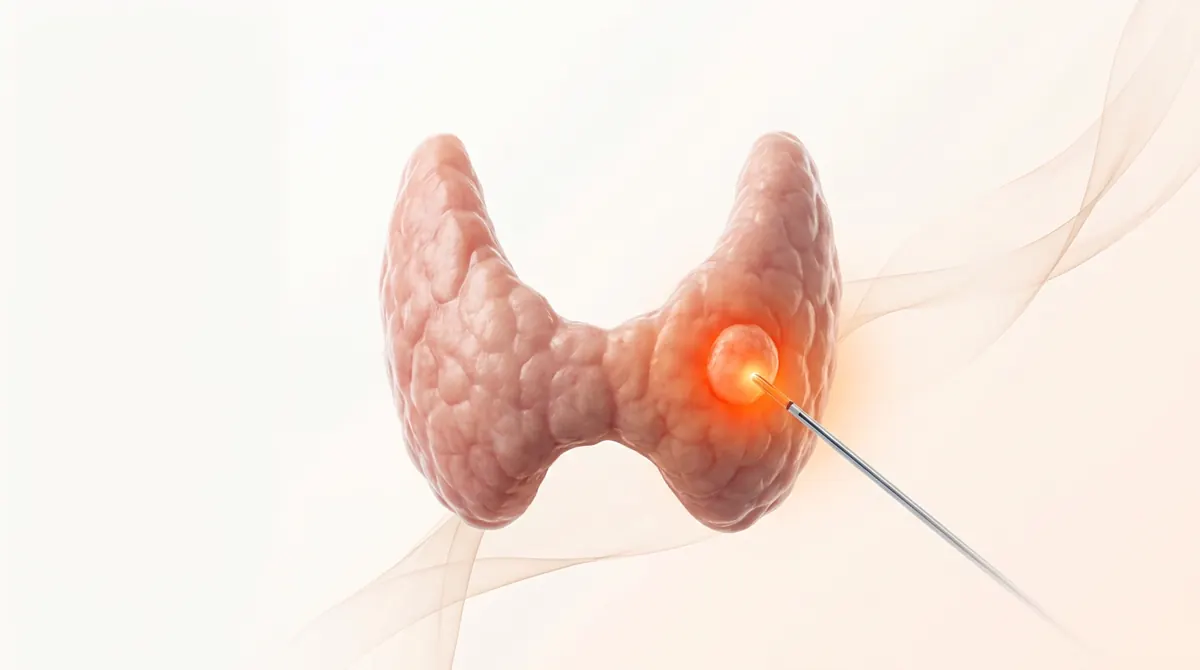
Surgery removes part or all of the thyroid through a neck incision under general anaesthesia. Ablation places a thin electrode into the nodule under ultrasound guidance and heats it with radiofrequency or microwave energy, so the nodule shrinks over the following months while the rest of the gland is left in place [3].
| Thyroid surgery | Ablation (RFA or microwave) | |
|---|---|---|
| Anaesthesia | General anaesthesia | Local anaesthesia, needle guided by ultrasound |
| Skin | Neck incision and scar | No incision, only a needle entry point |
| Hospital stay | 6.6 days on average in one 200-patient surgical group [7] | Day-care procedure, home the same day. At Clinic Seven, most patients are back to normal activity within a day or two |
| Thyroid function | Hypothyroidism in about 22% after removing one lobe [8] | Preserved in most patients [5, 7] |
| The nodule | Removed completely | Shrinks substantially over months: 93% volume reduction in a five-year series [10] |
| Tissue diagnosis | Full pathology report | Decided by biopsy before the procedure |
How well does ablation work?
In a prospective study of 345 patients across five Korean institutions, using a standard protocol, the mean nodule volume fell by 80.3% at 12 months, 84.3% at 24 months and 89.2% at 36 months. Symptom and cosmetic scores improved significantly and the major complication rate was 1.0% (3 of 276 treated nodules followed for at least a year) [4].
A North American multi-institutional study of 233 nodules found a median reduction of 73% at six months and 76% at 12 months. All patients were euthyroid at three months, and two had temporary hoarseness [5].
Safety has also been studied at scale. In 1,459 patients treated at 13 centres, 48 complications (3.3%) were recorded: 20 major, including voice change in 15 patients, and 28 minor, mostly small haematomas. All patients recovered spontaneously except two [6].
Jung et al., Korean Journal of Radiology 2018 [4]. Mean volume reduction in nodules that completed each follow-up.
Surgery and ablation in the same study
One of the few direct comparisons followed 200 patients who had surgery and 200 who chose radiofrequency ablation for benign nodular goitre, for one year. Complications were more frequent after surgery (6.0% versus 1.0%), residual nodules were more frequent (11.9% versus 2.9%) and hypothyroidism was found in 71.5% of surgical patients but none of the ablation patients. Surgical patients stayed in hospital for 6.6 days on average [7], while ablation at Clinic Seven is done as a day-care procedure with same-day discharge.
This was a non-randomised comparison, and the right plan for any one patient depends on the nodule and thyroid function, which is what your consultation covers.
Che et al., AJNR 2015, 200 patients per group, not randomised [7].
When surgery is still the right tool
Surgery removes the nodule completely and gives a full pathology report, and it is the standard treatment for suspicious or cancerous nodules and for very large goitres that compress the windpipe or food pipe. The ETA lists surgery as the standard approach for benign cold nodules that need intervention [3].
Surgery also has things to weigh up. A meta-analysis of 32 studies estimated that about 22% of patients develop hypothyroidism after hemithyroidectomy (removal of one lobe), including an estimated 12% subclinical and 4% clinical hypothyroidism in the four studies that separated them, and that a positive anti-thyroid peroxidase antibody test before surgery raises the risk [8]. After total thyroidectomy, lifelong thyroid hormone tablets are needed.
A US national analysis of 62,722 thyroid operations found complications in 20.4% of total thyroidectomies against 10.8% of unilateral operations, and surgeons who operate on thyroids more often had better outcomes [9].
Long-term results of ablation
In a Taiwanese series of 160 patients followed for up to five years, nodule volume fell by 93% overall, and about 90% of nodules did not regrow (the overall regrowth rate was 9.8%, at an average of 2.8 years). None needed retreatment because of regrowth in that series [10].
Experienced operators treat the edges of the nodule carefully to give the best long-term result [11]. The KSThR guideline allows additional treatment if symptoms are not fully relieved, and the ETA notes that repeat treatment remains available if it is ever needed [2, 3]. Follow-up ultrasounds are simply part of good care.
Radiofrequency or microwave?
Both are used for thyroid nodules, and Clinic Seven offers both, so the technique can be matched to your nodule. A randomised multicentre trial of 152 patients with predominantly solid benign nodules found that microwave ablation was as effective as radiofrequency ablation, with technique efficacy of 91% versus 86% [12].
Who tends to suit which option
These are patterns from the guidelines, not rules. The right choice is made after ultrasound, biopsy, thyroid blood tests and a conversation about your priorities.
- Ablation is often discussed for biopsy-confirmed benign solid or mostly solid nodules that cause a visible lump or pressure symptoms, in people who want to avoid a neck scar, keep their thyroid function, or are less suited to general anaesthesia [2, 3].
- Surgery is usually preferred when a nodule is suspicious or cancerous, when it is very large or compressing the airway, or when the patient wants a single definitive operation and accepts the trade-offs [3].
- Observation is reasonable for small benign nodules that cause no symptoms. Treatment is for problems, not for every nodule [1].
Questions to ask at your consultation
Bring your thyroid ultrasound, biopsy (FNAC or Bethesda) report and thyroid function tests, and ask:
- Has my nodule been proven benign, and how many biopsies support that?
- Is the nodule large or compressive enough that surgery is the safer route?
- How much shrinkage is realistic for a nodule like mine, and over what time?
- What is the plan if it regrows or if my symptoms do not settle?
- What are the chances I will need thyroid tablets with each option?
Frequently asked questions
- Can thyroid ablation replace surgery for a benign nodule?
- For many biopsy-confirmed benign nodules, yes. Ablation reliably shrinks the nodule, relieves symptoms and keeps the thyroid working, with no neck scar [4, 5], and the ETA and KSThR guidelines recognise it as an alternative to surgery [2, 3]. Surgery is reserved for suspicious or cancerous nodules and very large goitres.
- Will I need thyroid tablets after ablation?
- Most patients do not. In a 200-patient ablation group none developed hypothyroidism at one year [7], and all patients in a North American cohort were euthyroid at three months [5]. Your TSH is still checked after treatment, and tablets are started only if it is needed.
- Can the nodule come back after ablation?
- Uncommonly. In a five-year series nodule volume fell by 93% overall and about 90% of nodules did not regrow [10]. Follow-up ultrasounds are part of care, and repeat treatment is available if it is ever needed [2, 3].
- Is thyroid ablation safe for the voice?
- Yes, with an experienced operator. In a 1,459-patient series the overall complication rate was 3.3%, and nearly all patients recovered spontaneously [6]. Guiding the needle with ultrasound and keeping the energy away from the nerve is part of the technique.
- Where can I get thyroid nodule ablation in Hyderabad?
- Dr. Nagateja Bonala offers thyroid radiofrequency and microwave ablation at Clinic Seven, Kukatpally. Please bring your thyroid ultrasound, FNAC report and thyroid function tests to the consultation.
References
- Haugen BR, et al. 2015 American Thyroid Association Management Guidelines for Adult Patients with Thyroid Nodules and Differentiated Thyroid Cancer. Thyroid. 2016;26(1):1-133. Read the source
- Kim JH, et al. 2017 Thyroid Radiofrequency Ablation Guideline: Korean Society of Thyroid Radiology. Korean J Radiol. 2018;19(4):632. Read the source
- Papini E, et al. 2020 European Thyroid Association Clinical Practice Guideline for the Use of Image-Guided Ablation in Benign Thyroid Nodules. Eur Thyroid J. 2020;9(4):172-185. Read the source
- Jung SL, et al. Efficacy and Safety of Radiofrequency Ablation for Benign Thyroid Nodules: A Prospective Multicenter Study. Korean J Radiol. 2018;19(1):167-174. Read the source
- Kandil E, et al. Efficacy and Safety of Radiofrequency Ablation of Thyroid Nodules: A Multi-institutional Prospective Cohort Study. Ann Surg. 2022;276(4):589-596. Read the source
- Baek JH, et al. Complications encountered in the treatment of benign thyroid nodules with US-guided radiofrequency ablation: a multicenter study. Radiology. 2012;262(1):335-342. Read the source
- Che Y, et al. Treatment of Benign Thyroid Nodules: Comparison of Surgery with Radiofrequency Ablation. AJNR Am J Neuroradiol. 2015;36(7):1321-1325. Read the source
- Verloop H, et al. Risk of hypothyroidism following hemithyroidectomy: systematic review and meta-analysis of prognostic studies. J Clin Endocrinol Metab. 2012;97(7):2243-2255. Read the source
- Hauch A, et al. Total thyroidectomy is associated with increased risk of complications for low- and high-volume surgeons. Ann Surg Oncol. 2014 Nov. Read the source
- Lu CY, et al. Long-Term Outcomes of Radiofrequency Ablation for Benign Thyroid Nodules of Different Sizes: Implications of Regrowth and New Growth. Kaohsiung J Med Sci. 2026 Jan. Read the source
- Sim JS, Baek JH. Long-Term Outcomes Following Thermal Ablation of Benign Thyroid Nodules as an Alternative to Surgery: The Importance of Controlling Regrowth. Endocrinol Metab (Seoul). 2019;34(2):117-123. Read the source
- Chen S, et al. Microwave versus Radiofrequency Ablation in Treating Predominantly Solid Benign Thyroid Nodules: A Randomized Controlled Trial. Radiology. 2024;313(1):e232162. Read the source
Want to discuss your options?
Speak with the Clinic Seven team.