Patient guide
Thyroid nodule embolization vs ablation: what the evidence says
Thyroid artery embolization and thermal ablation (radiofrequency or microwave) compared: how each works, the evidence behind them, the risks, and which patients each may suit, with references.
Advantages over surgery at a glance
- No neck scarA needle or thin tube, no cut
- Thyroid keeps workingMost people avoid thyroid tablets
- Low complication ratesFewer problems than surgery
- Local anaesthesiaNo general anaesthesia
- Strong shrinkageThe nodule shrinks a lot over time
- Large goitres tooEmbolization can help

Two different ideas
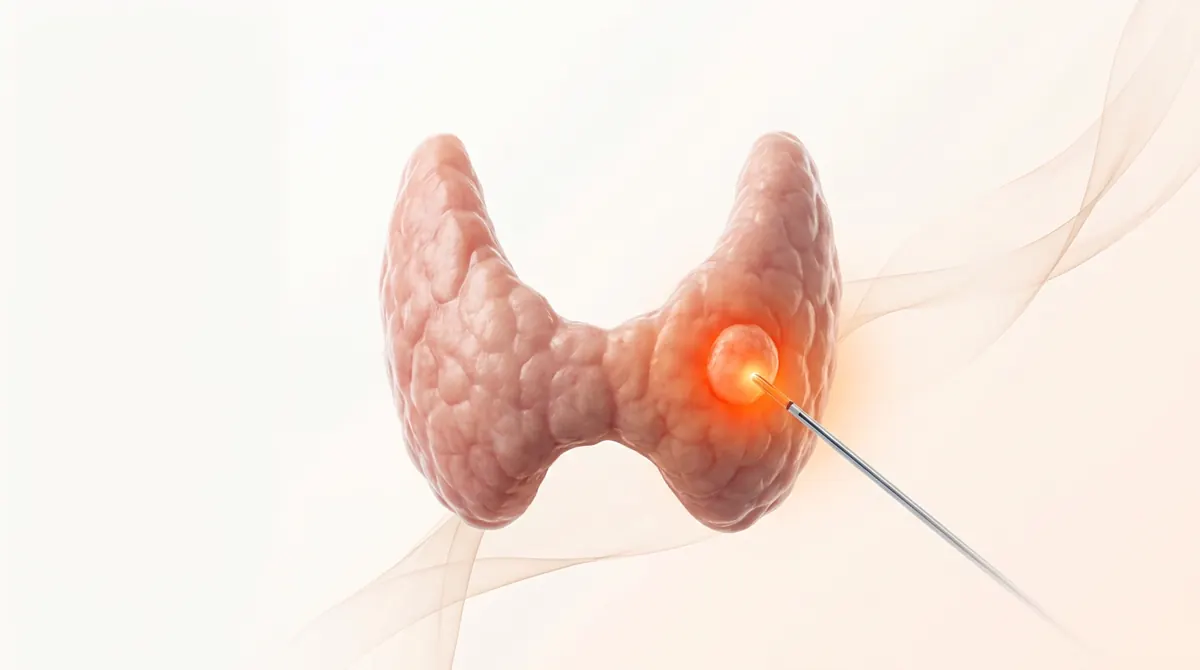
Thermal ablation, with radiofrequency or microwave energy, places a thin electrode into the nodule under ultrasound guidance and heats the tissue until it dies. The nodule then shrinks as the body absorbs it [1].
Thyroid artery embolization (TAE) works from the other side. A catheter is guided to the arteries that feed the thyroid, the superior and sometimes the inferior thyroid artery, and tiny particles are injected to reduce the blood flow [4]. The thyroid tissue that loses its blood supply shrinks over the following months.
Because they act differently, they suit different problems, and they do not have the same level of evidence.
Why people choose these options
People who look into image-guided thyroid treatment want to avoid the neck incision and keep their thyroid working. Here is what draws them to each option.
- Ablation: no neck scar, the thyroid stays in place, and an average 80% shrinkage at 12 months in a 345-patient study [3].
- Ablation: recognised in the ETA and KSThR guidelines for symptomatic benign nodules, with a 3.3% complication rate in 1,459 patients [1, 2, 8].
- Embolization: for very large or retrosternal goitres, nodule volume fell from 80.2 mL to 25.0 mL at six months in one specialist series [5].
- Embolization: in a multicentre comparison, volume reduction for nodules over 100 mL was 63.3% [6].
- Ablation: a day-care procedure. At Clinic Seven, most patients go home the same day and are back to normal activity within a day or two.
Advantages over surgery: what you can avoid
Compared with thyroid surgery, image-guided treatment lets you avoid the neck scar and several of the problems that follow an operation on the thyroid. These are the main ones.
- A neck incision and scar. Ablation uses a needle entry point, and embolization works through a catheter.
- Hypothyroidism. After surgery, 71.5% of patients in one 200-patient comparison had hypothyroidism against none after ablation, and about 22% develop it after removal of one lobe [10, 11].
- Complications and a long stay. In that comparison complications were 6.0% after surgery against 1.0% after ablation, and surgical patients stayed a mean of 6.6 days [10]. Ablation at Clinic Seven is a day-care procedure with same-day discharge.
- General anaesthesia. Ablation is done under local anaesthesia, with the needle guided by ultrasound.
How strong is the evidence for each?
The difference in the evidence base is the most important point when comparing the two.
| Thermal ablation | Thyroid artery embolization | |
|---|---|---|
| Guideline support | Recognised in the ETA and KSThR guidelines for symptomatic benign nodules [1, 2] | Used at specialist centres for selected patients, such as very large or retrosternal goitres [4, 7] |
| Patients studied | Mean nodule volume 14 mL (up to 81 mL) in one multicentre study of 345 patients [3] | Mostly large or retrosternal goitres, 47 of 56 patients in one series [5] |
| Shrinkage reported | Mean 80% at 12 months [3] | Nodule volume from 80.2 mL to 25.0 mL at 6 months [5] |
| Safety record | 3.3% complication rate in 1,459 patients, nearly all recovered spontaneously [8] | Reported from experienced specialist centres [4, 5] |
| Type of evidence | Large multicentre cohort studies [3, 8] | Specialist-centre case series and comparisons [4, 5] |
What the embolization studies show
A single-centre report from Turkey followed 56 consecutive patients over 5.5 years. Most had large goitres (47 had a retrosternal extension) and 25 had hyperthyroidism. Six months after embolization the mean nodule volume had fallen from 80.2 mL to 25.0 mL, the mean thyroid volume from 147.0 mL to 62.6 mL, and the extension into the chest from 31.7 mm to 15.9 mm. Of 22 patients with non-Graves hyperthyroidism, 19 became euthyroid, and patient-reported symptom scores improved [5].
These results come from an experienced specialist centre [5], which is where this technique is best performed.
Yilmaz et al., J Vasc Interv Radiol 2021, 56 patients, single centre [5].
Head to head for very large nodules
A retrospective multicentre study from Taiwan compared 53 patients treated with radiofrequency ablation and 17 with embolization for large benign nodules. At six months the embolization group had a higher volume reduction, and for nodules over 100 mL it was 63.3% against 49.7% for ablation. Complications were 5.3% with embolization and 14.0% with ablation, where transient hoarseness and haematoma were the common ones. Both treatments improved symptoms and appearance [6].
The authors concluded that embolization may serve as a minimally invasive alternative to surgery for large nodules. Larger studies will show how widely this applies, and the choice is made case by case.
Lee et al., European Radiology 2026, retrospective, 17 embolization and 53 ablation patients [6].
Where embolization fits
A 2026 review by interventional radiologists describes embolization as an emerging option, particularly for patients who are poor surgical candidates or who decline surgery [7]. A systematic review of 24 studies likewise recommends that it is performed at specialist centres with extensive embolization experience, for patients in whom standard treatments cannot be used [4]. That is why embolization is offered selectively, after a careful assessment, while ablation is the established first choice for most benign nodules.
By comparison, ablation complications in a 1,459-patient series were 3.3%, mostly minor [8].
Where each option may fit
These are patterns from the literature, not a recommendation for any one patient. Treatment is decided after ultrasound, a biopsy-confirmed benign diagnosis, thyroid blood tests and, for complex cases, discussion between an endocrinologist, a thyroid surgeon and an interventional radiologist.
- Ablation is the better-established choice for biopsy-confirmed benign solid or mostly solid nodules that cause symptoms or cosmetic concern, and it is the option the ETA and KSThR guidelines address [1, 2].
- Embolization may be discussed for very large or retrosternal goitres where ablation is hard to complete, or for patients who cannot or do not want surgery, and only at a centre experienced in thyroid embolization [4, 6, 7].
- Surgery remains the standard for suspicious or cancerous nodules and for goitres that compress the airway or food pipe, and it is covered in our guide to ablation versus surgery.
Questions to ask at your consultation
If embolization is suggested for you, these questions help you understand why:
- Has my nodule been proven benign on biopsy?
- Why is embolization being suggested instead of ablation or surgery for my nodule?
- How many thyroid embolizations has the operator performed, and what were the results?
- What are the specific serious risks, and how are they minimised?
- What is the plan if the thyroid does not shrink enough or the nodule regrows?
Frequently asked questions
- Which is better, ablation or embolization?
- They suit different problems. Ablation is the established first choice for most benign thyroid nodules, backed by guidelines and large multicentre studies [1, 2, 3], with a 3.3% complication rate in a 1,459-patient series [8]. Embolization is considered at specialist centres for selected patients, such as very large goitres, where one study saw 63% shrinkage against 50% with ablation [6].
- Can embolization treat an overactive thyroid nodule?
- Some series report improved thyroid function. In one, 19 of 22 patients with non-Graves hyperthyroidism became euthyroid [5], and embolization is considered selectively at specialist centres [4]. For autonomously functioning nodules the ETA lists radioactive iodine as first-line treatment, with ablation considered in selected young patients with small nodules [1].
- Which has a longer track record, ablation or embolization?
- Ablation. The multicentre complication series cited here began treating patients in 2002 [8], and long-term follow-up of up to five years is reported [9]. Evidence on long-term outcomes after embolization is limited [4].
- Can the nodule grow back after either treatment?
- Uncommonly after ablation: in a five-year series about 90% of nodules did not regrow [9], and follow-up scans pick up any change early so it can be treated. Long-term data after embolization are still being gathered [4].
- Where can I get thyroid nodule ablation in Hyderabad?
- Dr. Nagateja Bonala offers thyroid radiofrequency and microwave ablation at Clinic Seven, Kukatpally. Please bring your thyroid ultrasound, FNAC report and thyroid function tests to the consultation.
References
- Papini E, et al. 2020 European Thyroid Association Clinical Practice Guideline for the Use of Image-Guided Ablation in Benign Thyroid Nodules. Eur Thyroid J. 2020;9(4):172-185. Read the source
- Kim JH, et al. 2017 Thyroid Radiofrequency Ablation Guideline: Korean Society of Thyroid Radiology. Korean J Radiol. 2018;19(4):632. Read the source
- Jung SL, et al. Efficacy and Safety of Radiofrequency Ablation for Benign Thyroid Nodules: A Prospective Multicenter Study. Korean J Radiol. 2018;19(1):167-174. Read the source
- Coerts HI, et al. Thyroid Arterial Embolization for the Management of Benign and Malignant Thyroid Disease: A Systematic Review. Endocr Pract. 2026;32(1):67-76. Read the source
- Yilmaz S, et al. Thyroid Embolization for Nonsurgical Treatment of Nodular Goiter: A Single-Center Experience in 56 Consecutive Patients. J Vasc Interv Radiol. 2021;32(10):1449-1456. Read the source
- Lee YJ, et al. Transarterial embolization outperforms radiofrequency ablation for thyroid goiters exceeding 100 mL: a study on efficacy and safety. Eur Radiol. 2026;36(1):708-718. Read the source
- Sag AA, et al. Thyroid Artery Embolization for Benign Thyroid Hyperplasia. J Clin Med. 2026;15(7):2664. Read the source
- Baek JH, et al. Complications encountered in the treatment of benign thyroid nodules with US-guided radiofrequency ablation: a multicenter study. Radiology. 2012;262(1):335-342. Read the source
- Lu CY, et al. Long-Term Outcomes of Radiofrequency Ablation for Benign Thyroid Nodules of Different Sizes: Implications of Regrowth and New Growth. Kaohsiung J Med Sci. 2026 Jan. Read the source
- Che Y, et al. Treatment of Benign Thyroid Nodules: Comparison of Surgery with Radiofrequency Ablation. AJNR Am J Neuroradiol. 2015;36(7):1321-1325. Read the source
- Verloop H, et al. Risk of hypothyroidism following hemithyroidectomy: systematic review and meta-analysis of prognostic studies. J Clin Endocrinol Metab. 2012;97(7):2243-2255. Read the source
Want to discuss your options?
Speak with the Clinic Seven team.