Patient guide
Diabetic foot ulcer that will not heal: opening blocked leg arteries to save the limb
Why a diabetic foot ulcer may not heal, how blocked leg arteries are found, how angioplasty and stenting can restore blood flow without surgery, what the BEST-CLI and BASIL-2 trials show, and why wound care still matters.
Limb-saving angioplasty at a glance
- No surgical incisionA small puncture at the groin or ankle
- Local anaestheticYou stay awake
- Restores blood flowSo the wound can heal
- Short stayOften 1 to 2 days
- About 1-2 hoursFor most procedures
- Can be repeatedIf an artery narrows again




Why diabetic foot ulcers fail to heal
Three problems commonly combine in a diabetic foot ulcer: nerve damage (so pressure and injury go unnoticed), infection, and poor blood supply from narrowed leg arteries. Nerve damage and infection are treated with off-loading, wound care and antibiotics. But if the arteries are blocked, the foot cannot receive the oxygen and nutrients needed to heal, and the ulcer may linger, deepen or become gangrenous. In the worst case the limb is lost, which is why checking the blood flow matters.
Warning signs that need urgent attention
See a doctor the same day for any of these.
- A foot ulcer that is deepening, spreading or not improving after several weeks of good care.
- Spreading redness, swelling, pus or a bad smell.
- Pain in the foot or toes at rest, especially at night, relieved by hanging the leg down.
- A cold, pale or bluish foot, or toes that are turning dark.
- Fever or feeling unwell with a foot wound.
How blocked arteries are found
Your doctor checks the foot pulses and measures blood pressure in the ankle and toes. Doppler ultrasound shows where the arteries are narrowed. For planning treatment, a CT or MR angiogram, or a direct angiogram, maps the blockages from the groin to the foot. The intersocietal guidelines on diabetes and foot ulcers advise assessing the circulation in anyone with a foot ulcer and considering revascularisation when healing stalls [1].
How angioplasty and stenting are done
Most procedures take 1 to 2 hours and are done under local anaesthetic.
- A small needle puncture is made in an artery at the groin, or sometimes at the ankle or foot.
- A guidewire is passed through the narrowed or blocked artery under X-ray.
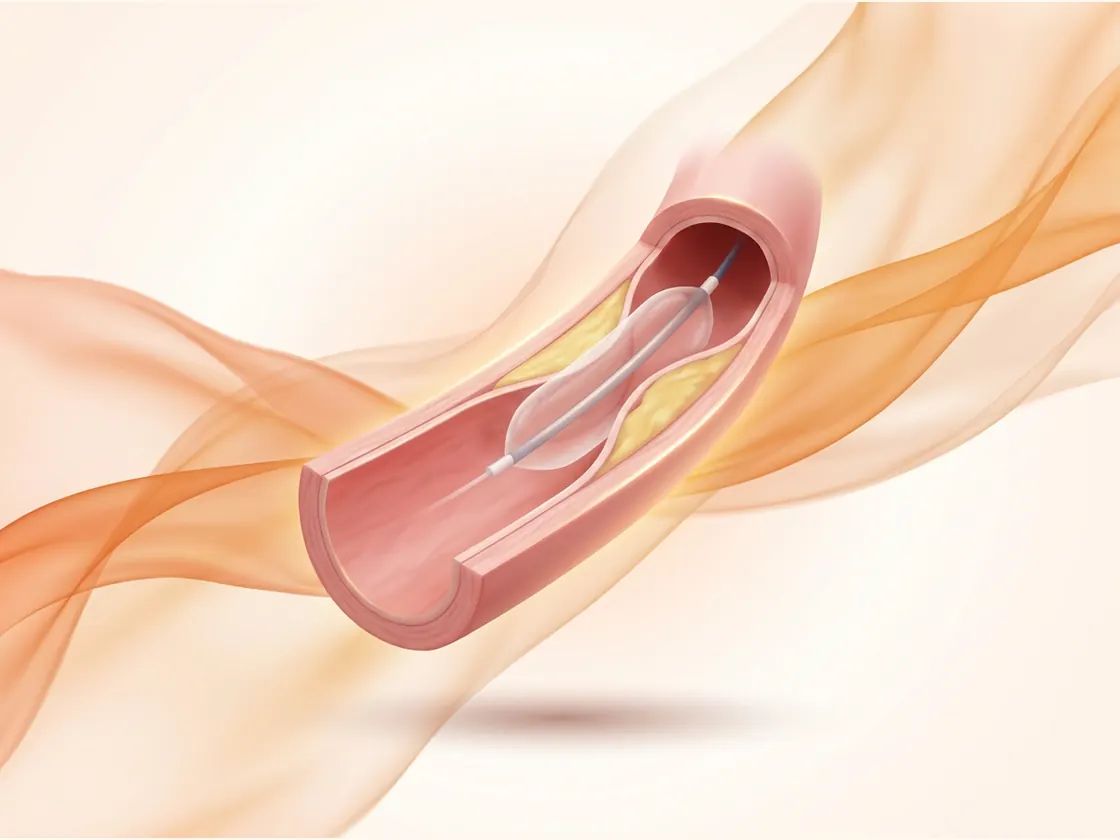
- A balloon is inflated to open the artery. A drug-coated balloon or a stent may be used in selected arteries.
- Dye confirms that blood is flowing down to the foot, and the puncture is closed.
- Wound care, off-loading and glucose control continue, because opening the artery helps the wound heal but does not replace them.
Angioplasty or bypass surgery?
Both are established ways to restore blood flow, and neither is right for everyone. The Global Vascular Guidelines advise a team decision, taking into account the pattern of blockages, whether a suitable vein is available for a bypass, and the person's overall fitness [2]. In the BEST-CLI trial, among 1,420 patients who had a good leg vein, the combined outcome of major limb events or death occurred in 42.6% of the surgery group and 57.4% of the endovascular group (hazard ratio 0.68). Among patients who lacked a good vein, outcomes were similar [3]. In the BASIL-2 trial of 345 patients needing treatment of the arteries below the knee, major amputation or death occurred in 63% after vein bypass first and 53% after a best-endovascular-first strategy, so for that pattern of disease the endovascular route did not do worse [4].
Farber et al., N Engl J Med 2022, cohort 1, 1,420 patients [3]. In patients without a good vein the results were similar.
Risks and what to expect
Risks of angioplasty include bleeding or a bruise at the puncture, an artery tear needing a stent, reaction to contrast dye (a concern if kidney function is poor), and the artery narrowing again, which may need repeat treatment. After a successful procedure the wound still needs careful care, and many ulcers take weeks to months to heal. If the foot is badly infected or gangrenous, drainage, antibiotics and sometimes removal of dead tissue or a toe are done alongside, and your team will say so.
If you are travelling for treatment
Diabetic foot problems can be urgent, so send your scans, wound photos and reports early. Dr. Nagateja Bonala reviews them and tells you whether angioplasty is likely to help, and our international patient team coordinates visa, travel and stay if you decide to come. See the international patients page for how this works.
Cost and insurance
Health insurance can cover these procedures, subject to your policy terms. The exact cost is calculated after consultation, a complete evaluation of the problem, and a decision on the procedure that suits you. Cashless treatment can be arranged with major Indian health insurers and TPAs, and credit treatment is available for CGHS and Singareni beneficiaries. Eligibility is confirmed after a policy check.
Frequently asked questions
- Why will my diabetic foot ulcer not heal?
- Often because the arteries to the foot are narrowed, so the wound cannot get the blood it needs, on top of nerve damage and infection. A vascular assessment shows whether this is the cause [1].
- Can blocked leg arteries be opened without surgery?
- Often yes. Balloon angioplasty, with or without a stent, opens the artery through a small puncture under local anaesthetic. Some people need bypass surgery instead, and a team decides [2, 3].
- Will angioplasty save my foot?
- It can restore the blood flow that healing needs and so lower the risk of amputation, but it cannot be promised. The wound, infection and glucose must be managed too, and results depend on how severe the disease is.
- How soon should an ulcer be assessed for blocked arteries?
- As soon as it is not improving despite good care, and the same day if there is infection, rest pain or darkening of the toes [1].
- Can I be treated if I travel from another country?
- Often yes. Send your scans, wound photographs and reports first so the doctor can advise whether angioplasty is likely to help before you travel. See the international patients page.
References
- Fitridge R, Chuter V, Mills J, et al. The intersocietal IWGDF, ESVS, SVS guidelines on peripheral artery disease in people with diabetes mellitus and a foot ulcer. J Vasc Surg. 2023;78(5):1101-1131. Read the source
- Conte MS, Bradbury AW, Kolh P, et al. Global Vascular Guidelines on the management of chronic limb-threatening ischemia. Eur J Vasc Endovasc Surg. 2019;58(1S):S1-S109. Read the source
- Farber A, Menard MT, Conte MS, et al. Surgery or endovascular therapy for chronic limb-threatening ischemia (BEST-CLI). N Engl J Med. 2022;387(25):2305-2316. Read the source
- Bradbury AW, Moakes CA, Popplewell M, et al. A vein bypass first versus a best endovascular treatment first revascularisation strategy for patients with chronic limb threatening ischaemia who required an infra-popliteal revascularisation (BASIL-2). Lancet. 2023;401(10390):1798-1809. Read the source
Want to discuss your options?
Speak with the Clinic Seven team.