Patient guide
Varicocele embolization vs surgery: what the evidence shows
How varicocele embolization compares with surgical repair: success and recurrence, pain relief, fertility and pregnancy rates, complications such as hydrocele, and who each option suits, with references.
Advantages over surgery at a glance
- No cuts, no scarsTreated from inside the vein
- Low complication ratesVery few problems after treatment
- Less swellingMuch lower hydrocele risk
- High success rateMost men are treated successfully
- Fertility benefitsCan improve pregnancy chances
- A second chanceWorks after failed surgery



What a varicocele is, and why treat it
A varicocele is a collection of enlarged veins above the testicle, caused by faulty valves in the veins that drain it. It is common, affecting an estimated 10 to 20% of men and about 40% of men with primary infertility, and it causes pain in a smaller number [3].
Not every varicocele needs treatment. Men usually consider it for a dragging or aching pain, for a visible swelling that bothers them, or because semen tests are abnormal while the couple is trying for a baby. The treatment choices are observation, surgery and percutaneous embolization [3].
Why men choose embolization
Men who look into embolization usually want a treatment that is gentle, quick to recover from and effective. Here is what draws them to it.
- No incision. The faulty vein is closed from inside the vein through a catheter, so there is no cut in the scrotum or groin [3].
- A very low complication rate: 1.78% with no major events in a 15-year review of 225 patients [3].
- A much lower risk of hydrocele, the fluid collection that can follow surgical ligation [2].
- A second chance after failed surgery: in the same review every man who had previously had failed surgery was treated successfully [3].
- Help with both pain and fertility goals: 70% of men referred for pain had clinical success [4], and 51% of men treated for subfertility went on to conceive [3].
- A quick recovery. At Clinic Seven, most patients are back to normal activity within a few days.
Advantages over surgery: what you can avoid
Compared with surgical ligation, embolization lets you avoid the wound and several of the complications that come with it. These are the main ones.
- A surgical incision in the scrotum or groin, and the scar and wound recovery that follow. The vein is closed from inside through a catheter [3].
- Hydrocele, a fluid collection around the testicle. In a meta-analysis of 30 studies the odds of hydrocele were about 80% lower after embolization (odds ratio 0.19) [2].
- Other surgical complications. Overall complication odds were about a third lower after embolization (odds ratio 0.65) [2].
- Starting again after a failed operation. A varicocele that came back after earlier surgery was treated successfully with embolization in every man in a 15-year review [3].
How embolization and surgery differ
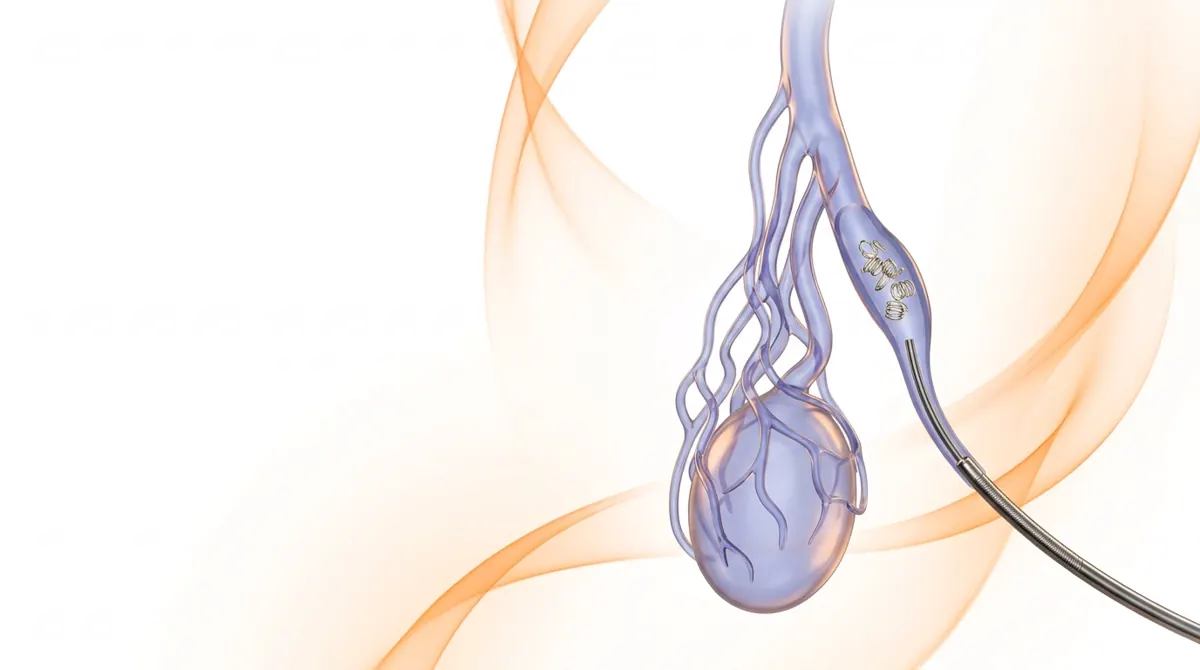
In embolization, a thin catheter is guided through a vein under X-ray imaging to the vein that feeds the varicocele, and the faulty vein is closed with coils or a sclerosing agent so blood is redirected through healthy veins [3]. Surgical repair ties off the veins through an incision. Embolization avoids the incision altogether, and the comparison below is based on published studies.
| Surgical ligation | Embolization (sclero-embolization) | |
|---|---|---|
| Approach | Incision, veins tied off | Catheter inside the vein, no incision |
| Overall complications | Higher | Lower (odds ratio 0.65) [2] |
| Hydrocele (fluid around the testicle) | More frequent | Much less frequent (odds ratio 0.19) [2] |
| Semen parameters | Improve | Improve, with a trend favouring embolization for sperm concentration [2] |
How reliably does embolization work?
A 15-year review of 225 patients treated at two tertiary centres reported a technical success rate of 96% and clinical success of 93.75%. Only 6.25% had a recurrence confirmed on ultrasound, the complication rate was 1.78% with no major events, and all of the men who had previously had failed surgery were treated successfully with embolization. The type of embolic material did not change the results [3].
Another 8-year series of 182 procedures found clinical success in 70.4% of men referred for scrotal pain [4]. An experienced team and careful technique are what deliver these results.
de Grae et al., CVIR Endovasc 2025, 225 patients, retrospective [3].
Does treatment help fertility?
Varicoceles are found in about 40% of men with primary infertility [3], and treating them is one of the few correctable causes of male subfertility. A Cochrane review of 48 trials with 5,384 participants found that treating a varicocele may improve pregnancy rates: couples with no treatment or delayed treatment had about a 21% chance of pregnancy, compared with between 22% and 48% after treatment [1].
After embolization specifically, the 15-year review reported that 51% of men treated for subfertility went on to conceive, and the technique worked even in men whose earlier surgery had failed [3]. Embolization also avoids the groin incision, so there is no surgical wound to heal.
de Grae et al., CVIR Endovasc 2025, 15-year review of 225 patients [3].
Pain relief
Scrotal pain is the other main reason men seek treatment. In the 8-year series, 70% of the men referred for pain had a clinical success, and the authors concluded that embolization is efficient and safe for painful varicocele [4]. A careful assessment first helps confirm the varicocele is the likely source.
Who tends to suit which option
These are patterns from the studies, not rules. The right choice follows your ultrasound, symptoms and fertility plans.
- Embolization is often discussed for men who prefer no incision, want a gentle day-care approach, have a varicocele that came back after earlier surgery, or want to avoid the risk of hydrocele [2, 3].
- Men trying for a baby with abnormal semen results are often advised to treat a palpable varicocele, because treatment improves the chance of pregnancy [1].
- Small varicoceles with no pain and normal semen results can simply be monitored.
Questions to ask at your consultation
Bring your scrotal Doppler ultrasound and, if you are trying for a baby, your semen analysis reports, and ask:
- Is my varicocele the likely cause of my pain or my semen results?
- How much improvement can I realistically expect, and over what time?
- How does embolization compare with surgery in my case?
- What is the plan if symptoms return?
- How soon can I get back to work and exercise?
Frequently asked questions
- Does varicocele embolization improve sperm count?
- Treating a varicocele can improve semen parameters and the chance of pregnancy [1]. A pooled analysis found sperm concentration improved after embolization, with a trend favouring it over surgical ligation [2], and 51% of men treated for subfertility went on to conceive in a 15-year review [3].
- Does embolization help varicocele pain?
- In an 8-year series, 70% of men referred for scrotal pain had clinical success after embolization [4]. A scan and examination first help confirm that the varicocele is the likely cause.
- Can a varicocele come back after embolization?
- Uncommonly. In a 15-year review, ultrasound confirmed recurrence in only 6.25% of patients, and embolization also worked in every man whose earlier surgery had failed [3].
- Is embolization safe?
- Yes. Published studies report a complication rate of just 1.78% with no major events in 225 patients [3], and a pooled analysis found fewer complications and much less hydrocele than surgical ligation [2].
- Where can I get varicocele embolization in Hyderabad?
- Dr. Nagateja Bonala offers varicocele embolization at Clinic Seven, Kukatpally. Please bring your scrotal Doppler ultrasound and any semen analysis to the consultation.
References
- Persad E, et al. Surgical or radiological treatment for varicoceles in subfertile men. Cochrane Database Syst Rev. 2021;4(4):CD000479. Read the source
- Chen H, et al. Comparison of sclero-embolization and surgical ligation for varicocele treatment: a systematic review and meta-analysis. World J Urol. 2025;43(1):627. Read the source
- de Grae MNM, et al. A fifteen-year retrospective analysis of varicocele embolization: evaluating success, recurrence rates and embolic agents. CVIR Endovasc. 2025;8(1):59. Read the source
- Haroun P, et al. Percutaneous Embolization for Painful Varicocele: An 8-Year Tertiary Centre Experience. J Belg Soc Radiol. 2025;109(1):2. Read the source
Want to discuss your options?
Speak with the Clinic Seven team.