Patient guide
Vascular malformations: types, symptoms and non-surgical treatment
What vascular malformations are, how venous, lymphatic and arteriovenous types differ, the symptoms, and how sclerotherapy, embolization and medicines are used instead of open surgery.
Advantages over surgery at a glance
- Type decidesVenous, lymphatic or AVM
- No open surgerySclerotherapy and embolization
- Often day careHome soon after
- MRI firstMaps the malformation
- Staged sessionsResults build over months

What a vascular malformation is
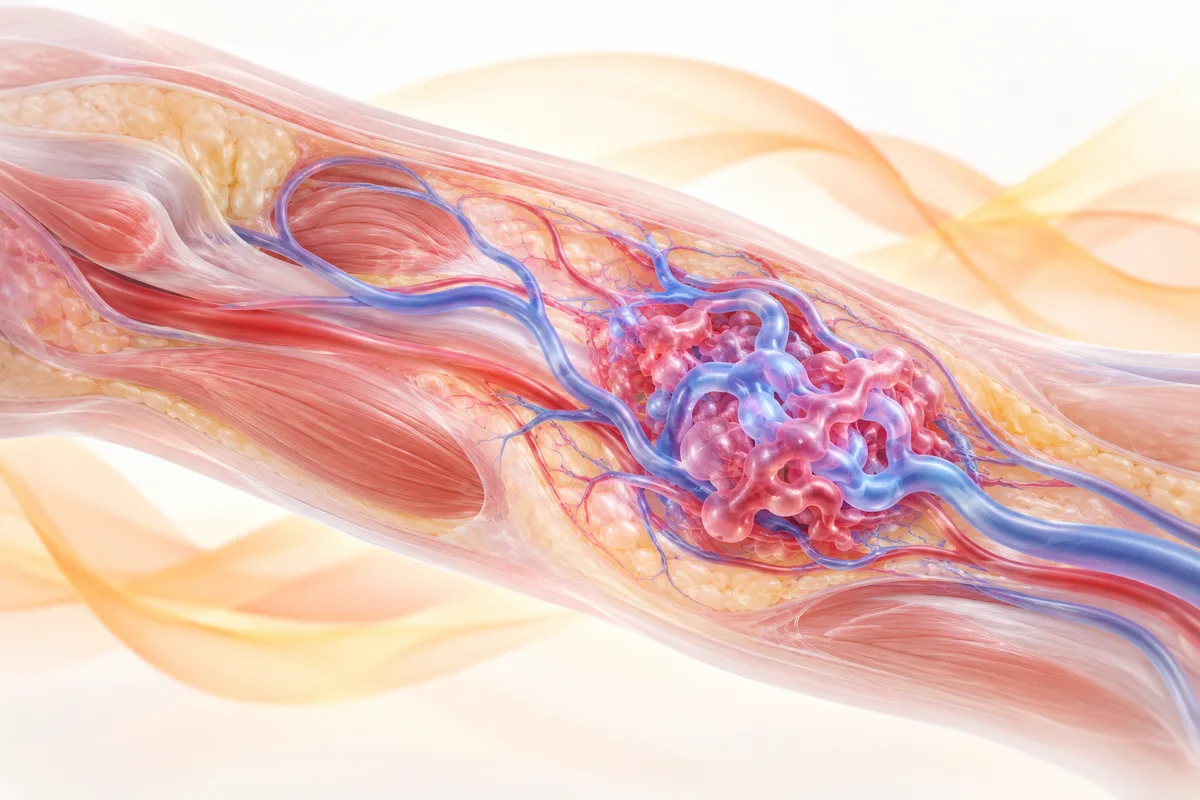
A vascular malformation is an area where blood vessels or lymph vessels did not form normally. The malformed vessels can be swollen, tangled or leaky. Doctors classify them using the ISSVA system, mainly by the type of vessel involved and whether blood flows slowly or quickly through them [1, 2].
The main types
Knowing the type is the first step because treatment differs.
| Type | Flow | What it looks and feels like | Usual approach |
|---|---|---|---|
| Venous | Slow | Blue, soft, compressible swelling that enlarges on dependent position | Sclerotherapy [1] |
| Lymphatic | Slow | Soft, fluid-filled swelling, sometimes in neck or limbs | Sclerotherapy [1] |
| Arteriovenous (AVM) | Fast | Warm, pulsating area, may bleed or cause pain | Embolization, sometimes with surgery [1] |
| Capillary | Slow | Flat pink or red patch (port-wine stain) | Often laser by a dermatologist |
Symptoms that need attention
Some malformations cause nothing but a visible mark. Others cause problems:
- Pain, throbbing or heaviness, especially after activity
- A swelling that gradually enlarges
- Bleeding, ulceration or skin breakdown
- Restricted movement of a limb or joint
- Warmth or a pulsating feel over the area
- Rapid growth during puberty, pregnancy or after injury
How treatment works without open surgery
For slow-flow venous and lymphatic malformations, a needle is guided into the abnormal channel under ultrasound and X-ray, and a sclerosant medicine is injected to shrink it. For fast-flow malformations, a catheter delivers glue, coils or particles to close the abnormal connections. Some slow-flow malformations also respond to medicines such as sirolimus in selected patients, decided by a specialist.
Most people need more than one session, and results build over months.
Planning at Clinic Seven
Dr. Nagateja Bonala reviews MRI and Doppler imaging to confirm the type, then explains whether sclerotherapy, embolization, medicines, surgery or observation fits. Bring all earlier scans and reports. Cashless insurance can be arranged for eligible policies.
Frequently asked questions
- Can a vascular malformation be removed completely?
- Complete removal is not always possible, especially for large or deep ones. The aim is to shrink the lesion, control symptoms and prevent complications. Many people do very well with staged treatment.
- Is sclerotherapy painful?
- It is performed under sedation or anaesthesia suited to the lesion, so you are comfortable. Swelling and soreness for several days afterwards are expected.
- Are vascular malformations cancerous?
- No. They are benign structural abnormalities of vessels, not cancers [1, 2].
- Do vascular malformations go away on their own?
- They do not regress by themselves and often grow in proportion to the person. Some stay stable and only need monitoring.
References
- Boston Children's Hospital. Vascular malformations, tumors, and hemangiomas. Read the source
- Boston Children's Hospital. Venous malformation. Read the source
Want to discuss your options?
Speak with the Clinic Seven team.