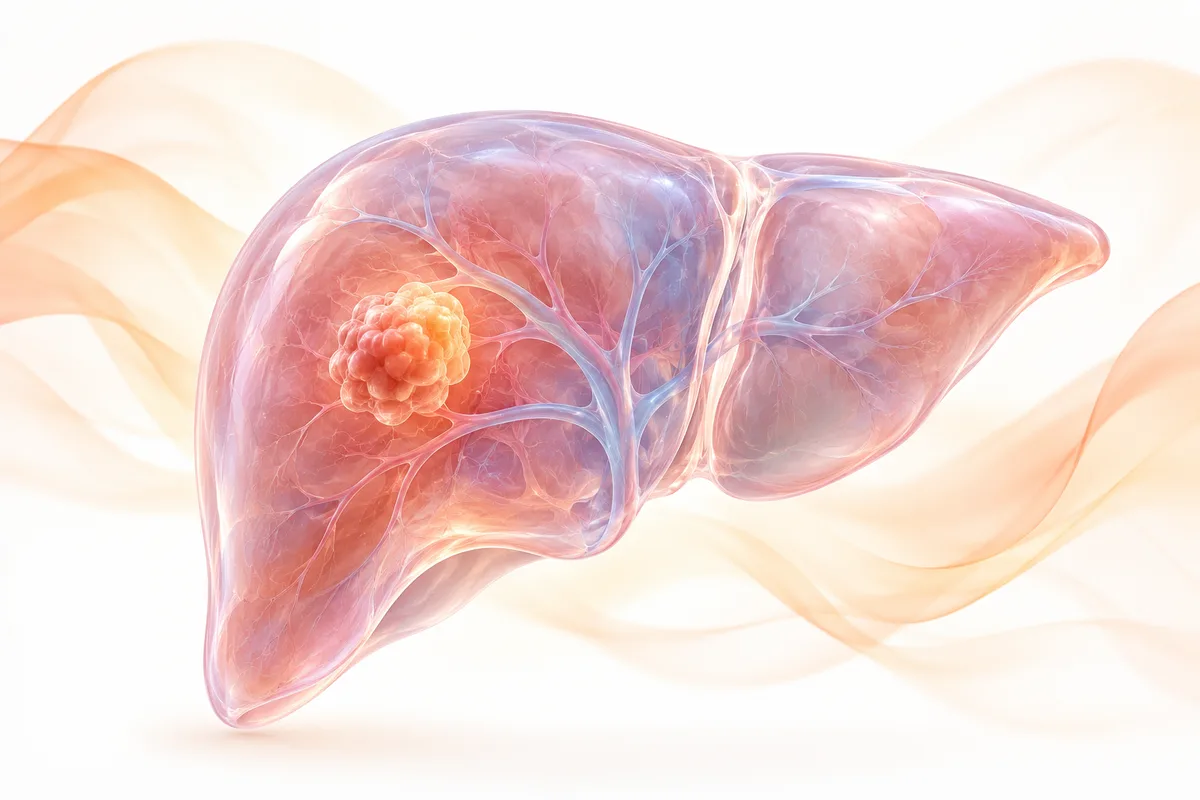
Patient guide
Microwave ablation for liver tumours: a needle-based alternative to liver surgery
How microwave ablation (MWA) destroys small liver tumours through a needle, who it suits, how it compares with radiofrequency ablation, recovery, risks and how the cost is worked out.
Microwave ablation at a glance
- No large incisionA needle antenna through the skin
- Curative intentFor very early and early stage HCC
- Less local progressionThan radiofrequency (RR 0.67)
- One nightUsual hospital stay
- About a weekTo normal routine


What microwave ablation is
A thin antenna is guided into the tumour through the skin, using CT or ultrasound. It generates microwave energy that heats the tissue around the tip and destroys the tumour along with a small margin. The area is checked on imaging during the procedure to confirm the tumour has been covered [1].
Who it suits
Ablation is considered mainly for small tumours. Your tumour board checks the details.
- Early-stage HCC, usually a single tumour or a small number of small tumours, with preserved liver function [1, 2].
- Selected liver metastases, for example from colorectal cancer, when the number and size are limited.
- Patients for whom a liver operation carries more risk.
- Tumours in a position the antenna can reach safely, away from major bile ducts and the gallbladder.
Microwave and radiofrequency ablation
Both heat the tumour. Microwave energy heats a larger area faster and is less affected by nearby blood vessels carrying heat away. In a 2026 meta-analysis of 38 studies with 8,347 participants, including 7 randomised trials, microwave ablation was associated with less local tumour progression than radiofrequency ablation (risk ratio 0.67), and overall survival and survival without recurrence were not significantly different [3].
Recovery and risks
Most people stay in hospital one night. Mild pain, low fever and tiredness for a few days are common. Risks are uncommon and your team explains them for your tumour, including bleeding, infection and, rarely, injury to nearby structures. Follow-up CT or MRI at about one month confirms the result.
Cost
Health insurance can cover this treatment, subject to your policy terms. The exact cost is calculated after consultation, a complete evaluation of the disease, and a decision on the treatment options. Cashless treatment can be arranged with major Indian health insurers and TPAs, and credit treatment is available for CGHS and Singareni beneficiaries. Eligibility is confirmed after a policy check.
Frequently asked questions
- Can a liver tumour be treated without surgery?
- Small tumours can be treated by microwave ablation, a needle-based procedure. Ablation is a curative-intent option for very early and early stage HCC [1, 2].
- Is microwave ablation better than radiofrequency ablation?
- In a 2026 meta-analysis, microwave had less local tumour progression (risk ratio 0.67), with no significant difference in overall survival [3].
- How big a tumour can be treated with ablation?
- Smaller tumours are treated most reliably. Larger or multiple tumours may be treated with TACE or a combination. Your scan decides.
- Is it painful?
- You are comfortable under sedation or anaesthesia. Mild pain and tiredness for a few days are common.
- How much does liver ablation cost in Hyderabad?
- Health insurance can cover this treatment, subject to your policy terms. The exact cost is calculated after consultation, a complete evaluation of the disease, and a decision on the treatment options.
References
- Reig M, Forner A, Rimola J, et al. BCLC strategy for prognosis prediction and treatment recommendation: The 2022 update. J Hepatol. 2022;76(3):681-693. Read the source
- EASL Clinical Practice Guidelines: Management of hepatocellular carcinoma. J Hepatol. 2018;69(1):182-236. Read the source
- Microwave Ablation Versus Radiofrequency Ablation for Hepatocellular Carcinoma: A Systematic Review and Meta-Analysis. Cureus. 2026. Read the source
Want to discuss your options?
Speak with the Clinic Seven team.