Prostate · Patient guideProstate problem:
which doctor to see? Prostate problem: which doctor to consult in Hyderabad, a urologist or an interventional radiologist?
A urologist diagnoses the problem. If you want to avoid surgery, an interventional radiologist can tell you whether PAE suits you.
At a glance
- Urologist for diagnosis
- Interventional radiologist for PAE
- Second opinion before surgery
- PAE: local anaesthesia



What the studies show
- Start with a urologist, or a doctor you trust, to find out what is causing your symptoms. They check your urine, a PSA blood test and an ultrasound of the prostate.
- Urologists treat prostate problems with tablets and with operations such as TURP and laser surgery.
- An interventional radiologist treats an enlarged prostate without cutting, using prostate artery embolization (PAE), and can tell you whether you are a candidate.
- You can book a consultation directly. You do not need a referral, and a second opinion is a normal, sensible step before surgery.
01
Which doctor should I see first for a prostate problem?
Usually a urologist or family doctor, for the first tests.
Read more
For most men the first step is a urologist, who is the specialist for the urinary system and the prostate, or a family doctor who can arrange the first tests. They will ask about your symptoms, check your urine, arrange a PSA blood test and an ultrasound of your prostate, and rule out other causes, including cancer.
This step matters because a weak stream, getting up at night and frequent urination can have more than one cause. Always get the cause found first.
02
What does an interventional radiologist do for the prostate?
Treat the prostate through a tiny puncture, without cutting.
Read more
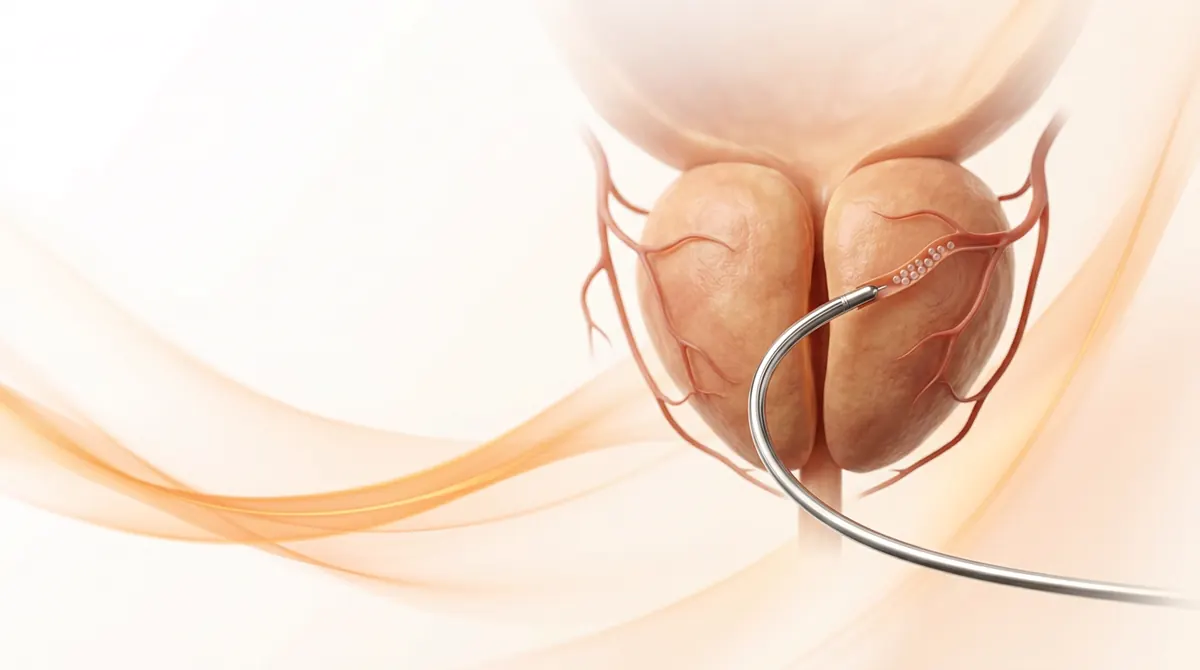
An interventional radiologist treats conditions through tiny punctures, guided by live X-ray imaging, without cutting. For an enlarged prostate the treatment is prostate artery embolization (PAE). A thin tube is guided to the small arteries that feed the prostate, and tiny particles reduce the blood flow, so the gland gradually shrinks. It is usually done under local anaesthesia, and most men go home the same day.
The Society of Interventional Radiology's 2026 guidance says PAE has gained a place in multiple guidelines, including the American Urological Association's most recent, as a viable option for urine symptoms caused by an enlarged prostate [1].
03
Urologist or interventional radiologist: how they fit together
Not rivals. One diagnoses, the other offers a no-surgery option.
| Urologist | Interventional radiologist | |
|---|---|---|
| Finds the cause of your symptoms | Yes | Reviews your reports and scans |
| Tablets for an enlarged prostate | Yes | No |
| Operations (TURP, laser, robotic) | Yes | No |
| Prostate artery embolization (PAE) | No | Yes |
| Treatment without cutting | Some procedures | PAE: nothing is cut or removed |
| Prostate cancer | Yes | No |
Read more
They are not rivals. A 2026 review of PAE says choosing carefully and making the decision together with both urology and interventional radiology is essential [2]. In practice:
04
When should I see an interventional radiologist?
Consider a consultation if any of these sound like you:
- You have been told you need an operation and want to know if there is a gentler option
- Tablets are not helping enough, or you do not want to take them for life
- You have a catheter and want to try to get rid of it
Read more
Consider a consultation if any of these sound like you:
- You have been told you need an operation and want to know if there is a gentler option
- Tablets are not helping enough, or you do not want to take them for life
- You have a catheter and want to try to get rid of it
- You are older or have other health problems that make surgery risky
- You are worried about your sex life after an operation
- A previous procedure did not do enough
05
What to bring to the consultation
Bring everything you have:
- Your prostate ultrasound or MRI report
- Your PSA blood test result
- A list of your medicines
Read more
Bring everything you have, and we will go through it with you:
- Your prostate ultrasound or MRI report
- Your PSA blood test result
- A list of your medicines
- Any report from a urologist, including a cystoscopy if you had one
06
Where to go in Hyderabad
Clinic Seven, Kukatpally.
Read more
Dr. Nagateja Bonala, an interventional radiologist, sees men for prostate artery embolization at Clinic Seven in Kukatpally, and at the Interventional Radiology OPD in Banjara Hills. You can book directly. Take the free prostate symptom score below first, if you like, and share the result with our team.
Not sure which is right for you?
Share your scan on WhatsApp or book a consultation. Dr. Nagateja Bonala will explain your choices.
FAQ
Common questions
Which doctor treats prostate problems?
A urologist is the usual first doctor, for diagnosis, tablets and operations. An interventional radiologist treats an enlarged prostate without cutting, using prostate artery embolization (PAE).
Do I need a referral to see an interventional radiologist?
No. You can book a consultation directly. Bring your prostate ultrasound, PSA result and medicines list.
Is PAE recognised by doctors' societies?
The Society of Interventional Radiology's 2026 guidance says PAE has gained a place in multiple guidelines, including the American Urological Association's most recent, as a viable option for urine symptoms caused by an enlarged prostate [1].
Should I get a second opinion before prostate surgery?
It is a sensible step. A second opinion lets you hear about every option, including ones that do not involve cutting, before you decide.
Where can I get PAE in Hyderabad?
Dr. Nagateja Bonala offers prostate artery embolization at Clinic Seven in Kukatpally and at the Interventional Radiology OPD in Banjara Hills.
Check your prostate symptom score
Sources (2)
- Mouli S, et al. Society of Interventional Radiology (SIR) 2026 Practice Guidance Document for Prostatic Artery Embolization. J Vasc Interv Radiol. 2026. Read the source
- Tawfellos G, et al. Prostatic Artery Embolization: A Contemporary Review of Efficacy, Safety, and Expanding Clinical Indications. Curr Urol Rep. 2026. Read the source
This guide is educational and cannot confirm diagnosis, procedure suitability, or cost. Treatment planning follows consultation, examination, and review of relevant imaging.