Patient guide
Worried about your sex life after prostate treatment? What PAE can mean for ejaculation and erections
Will prostate treatment affect ejaculation or erections? In a randomised trial, far fewer men lost ejaculation completely after PAE than after TURP (16% vs 52%). The honest picture, with the numbers, for men weighing their options.
Your sex life: what the studies show
- 3x less likely to lose ejaculation16 in 100 men after PAE vs 52 in 100 after TURP, the usual operation
- No significant drop in erection qualityIn 828 men followed for up to 2 years
- Erections improved for 4 in 10 menMen who already had some erection trouble
- No drop in ejaculation scoresOn average, for up to 2 years, in 828 men
- 77 studies, no significant effectOn erections or ejaculation, when put together
- No cuttingNothing removed from the prostate


Why men ask about sex before they choose a treatment
About 46% of men with urine symptoms from an enlarged prostate already report ejaculation problems, and treatments can change things further [4]. Yet it is the question men are most embarrassed to ask. If this matters to you, you are not alone, and it is a perfectly good reason to choose one treatment over another.
Ejaculation: what each treatment is linked to
The main effect on ejaculation is called retrograde ejaculation: the semen goes backwards into the bladder instead of coming out. It is harmless, but it can affect fertility and satisfaction.
| Treatment | What studies found |
|---|---|
| Tablets: alpha-blockers | Ejaculation problems in about 4 to 30 in 100 men [4] |
| Tablets: 5-alpha-reductase inhibitors | About 4 to 18 in 100 men [4] |
| TURP (the standard operation) | Retrograde ejaculation in about 50 to 70 in 100 men [4]. Total loss of ejaculation in 52% in the Swiss trial [1]. |
| Prostate artery embolization (PAE) | Total loss of ejaculation in 16% in the Swiss trial [1]. Reduced ejaculation in 40% [1]. In another study, 10% developed a problem [2]. In 828 men at one large centre, average ejaculation scores did not change significantly for up to 24 months [6]. |
What the Swiss trial found
This is the only randomised trial that compared the two directly and looked closely at ejaculation. After TURP, 52% of men lost ejaculation completely. After PAE, 16% did. But a further 40% of PAE men noticed their ejaculation had become weaker or smaller in volume [1]. In total, 56% of men after PAE reported some change.
In plain terms: with PAE you are much less likely to lose ejaculation completely, but you may well notice less.
Another, smaller study of 39 men found that 4 (10%) developed an ejaculation problem, and that men who left more urine in the bladder were more likely to be affected [2]. Both are honest signals that results differ between men, and that it is worth asking before treatment.
What the largest interventional radiology series show
The most detailed numbers come from centres that do a lot of PAE. At one US centre, 878 men were reviewed, 828 of them after standard PAE. Their erection scores were slightly higher than before treatment at 3 months and at 12 months, and the scores on the ejaculation questionnaire did not change significantly from before treatment at 3, 6, 12 or 24 months [6]. That is an average across all the men. Some individual men will have noticed a change, as the trial above shows.
In an international study of 478 men treated at several centres, the average symptom score fell from 21.8 to 9.3 at 3 months and was 11.2 at 24 months, and erection scores did not change (13.8 before, 13.9 a year later) [7].
Erections: usually unchanged, sometimes better
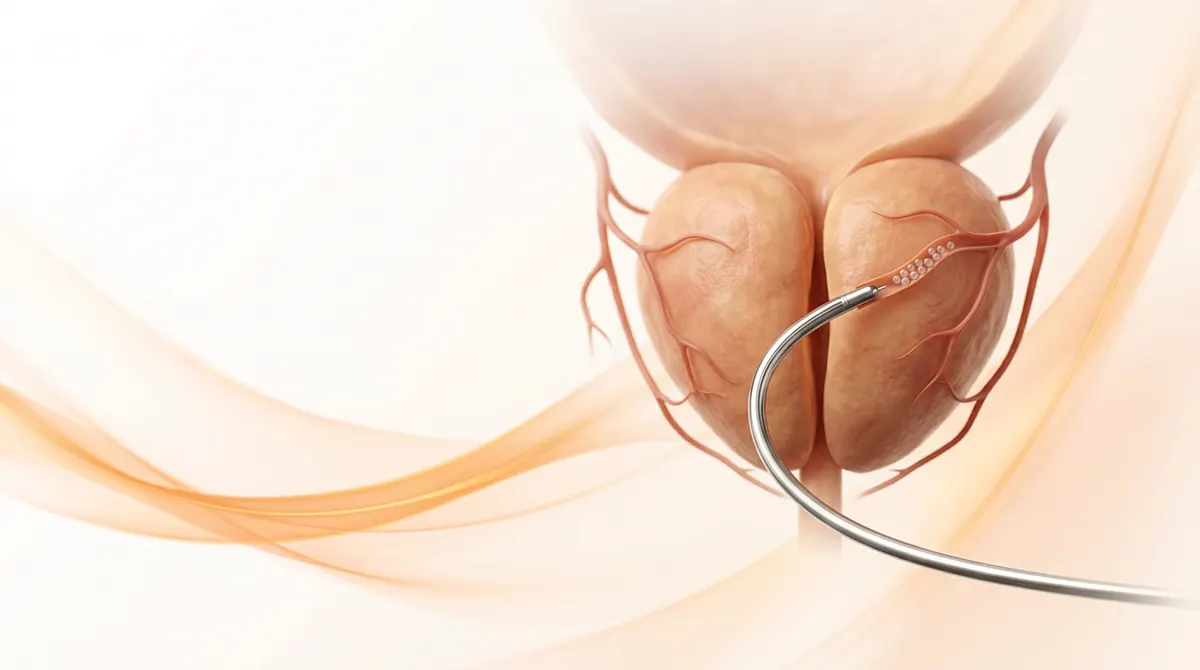
PAE works on the arteries of the prostate and not on the erection nerves. In a study of 167 men, erection scores were slightly better at 3 months and at 12 months. For 82% of men there was no change that mattered. Among men who already had mild to moderate erection problems, 38% said their erections improved. Among men with normal erections, 21% reported some decline [3].
The researchers concluded that PAE has no adverse effect on erections for most men [3]. The study was done at one centre and was not a controlled trial, so we describe it as encouraging and not as a guarantee.
How to use this when you decide
If keeping your sex life matters to you, these are the questions worth asking any doctor, including us:
- How likely is my treatment to change my ejaculation, and by how much?
- Do I still want to father children? If so, say this first.
- Would my prostate size and scans make PAE suitable, or would another option do better?
- What is the chance I will need more treatment later? (In a UK register, about 1 in 5 men, 20%, had another procedure after PAE [5].)
Check your symptoms, then talk to us
PAE is not for every man, and we will say so if it is not right for you. Our free symptom score takes two minutes, and you can send the result to us. At the consultation we go through your scans and your priorities, including your sex life, and tell you plainly what to expect.
Frequently asked questions
- Does PAE cause retrograde ejaculation?
- Far fewer men lose ejaculation than after TURP: 16 in 100 against 52 in 100 in a randomised trial [1]. Some men do notice less semen: 40 in 100 in that trial [1]. We talk it through before you decide.
- Will PAE affect my erections?
- For most men, no. In 167 men, 8 in 10 saw no meaningful change, and 4 in 10 of those who already had some erection trouble said it got better. About 1 in 5 men with normal erections noticed some decline [3]. Across 828 men followed for up to 2 years, erection scores did not drop [6].
- What do large PAE series show for ejaculation and erections?
- At one large interventional radiology centre, 828 men had standard PAE. Their ejaculation scores did not change significantly for up to 24 months, and erection scores were slightly better at 3 and 12 months [6]. These are averages, and individual men differ, which is why we talk it through before treatment.
- Does PAE affect sexual function overall?
- A 2026 analysis that pooled 77 studies and 11,477 men treated with minimally invasive prostate procedures found that PAE did not significantly affect erectile or ejaculatory function [8]. That is an overall result, and individual men differ, as the randomised trial shows [1].
- Is PAE better for sexual function than TURP?
- On ejaculation, men were much less likely to lose it completely after PAE than after TURP in the randomised trial [1]. Results differ between men, so we go through this at the consultation.
- I want more children. Can I have PAE?
- Tell us at the start. Both PAE and operations can affect ejaculation and fertility, and we plan around your wish to have children.
- Where can I discuss this in Hyderabad?
- Dr. Nagateja Bonala sees men for prostate artery embolization at Clinic Seven. You can talk openly about sexual function at the consultation.
Check your prostate symptom score
References
- Müllhaupt G, et al. Ejaculatory disorders after prostatic artery embolization: a reassessment of two prospective clinical trials. World J Urol. 2020. Read the source
- Young S, Moran P, Golzarian J. Ejaculatory dysfunction following prostate artery embolization: A retrospective study utilizing the male sexual health questionnaire-ejaculation dysfunction questionnaire. Diagn Interv Imaging. 2022. Read the source
- Bhatia S, et al. Effect of Prostate Artery Embolization on Erectile Function - A Single Center Experience of 167 Patients. J Sex Med. 2022. Read the source
- Couteau N, et al. Ejaculations and Benign Prostatic Hyperplasia: An Impossible Compromise? A Comprehensive Review. J Clin Med. 2021;10(24). Read the source
- Ray AF, et al. Efficacy and safety of prostate artery embolization for benign prostatic hyperplasia: an observational study and propensity-matched comparison with transurethral resection of the prostate (the UK-ROPE study). BJU Int. 2018. Read the source
- Richardson A, et al. Impact on Sexual Function of Protective Coil Embolization of Penile Collaterals During Prostatic Artery Embolization. Cardiovasc Intervent Radiol. 2025. Read the source
- Sapoval MR, et al. Two-Year Outcomes of Prostatic Artery Embolization for Symptomatic Benign Prostatic Hyperplasia: An International, Multicenter, Prospective Study. Cardiovasc Intervent Radiol. 2024. Read the source
Want to discuss your options?
Speak with the Clinic Seven team.