Patient guide
Stuck with a urinary catheter because of an enlarged prostate? How PAE can help you get rid of it
Living with a catheter because of an enlarged prostate? Studies show prostate artery embolization (PAE) got the catheter out for about 8 in 10 men, without a major operation. What it involves, who it suits and what to ask.
Why men with a catheter look at PAE
- No major operationDone through a tiny puncture
- You stay awakeOnly a numbing injection, no general anaesthetic
- Usually day-careMost men go home the same day
- Catheter out for about 8 in 10 menIn studies of men who had one
- Prostate shrinksAbout a fifth smaller in one study



Why a catheter is not a long-term answer
When an enlarged prostate squeezes the urine pipe so much that the bladder cannot empty, doctors put in a catheter. It saves you from pain and bladder damage in the short term. But living with one is hard. It can be uncomfortable, it needs changing, it can cause infections, and it limits travel, work and everyday confidence.
Many men are told the only way to be free of it is a prostate operation. That is not always possible. Some men are too unwell for an operation, and many simply do not want one. PAE gives a different route.
What PAE is, in plain words
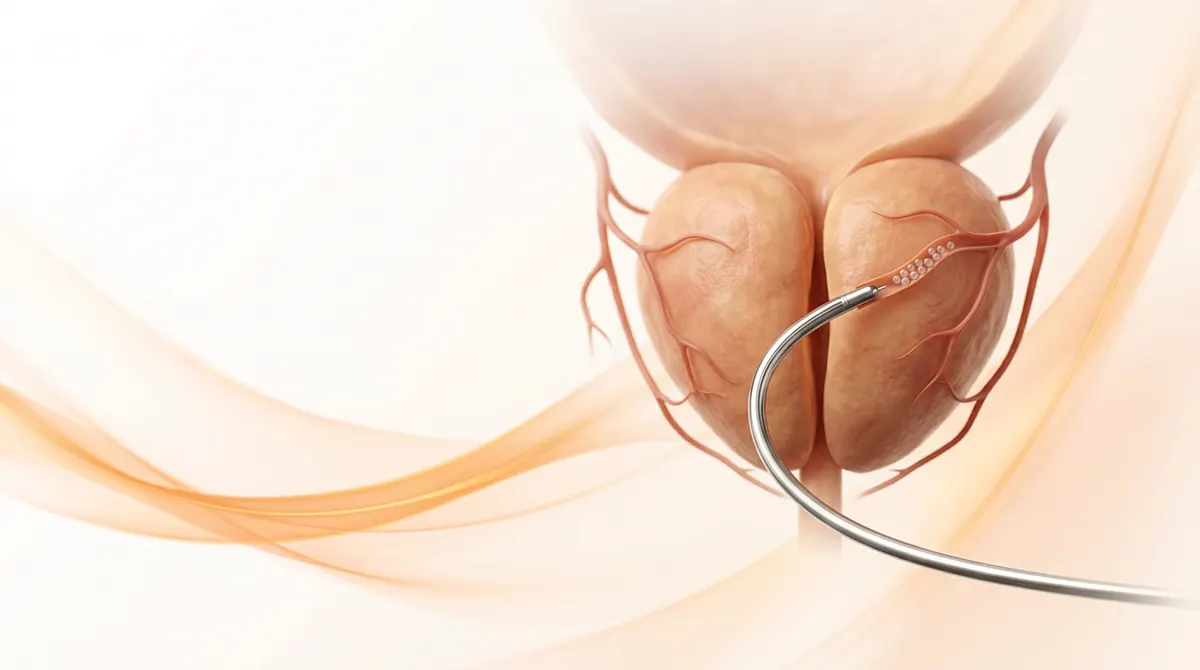
The prostate has its own small arteries. In PAE, a thin tube is guided through a tiny puncture in the wrist or groin to those arteries, and tiny particles are released to cut down the blood flow. Over the following weeks the prostate gets smaller and softer, and the urine pipe opens up. Nothing is cut and no tissue is removed. It is usually done under local anaesthesia, and most men go home the same day.
How often does the catheter come out?
Several studies have looked at exactly this question. They are small, and they are not all the same, so the numbers differ. But they point the same way: PAE can get the catheter out for most of the men it is used in.
| Who was studied | What happened |
|---|---|
| 43 men who were not fit for surgery and had a catheter for at least 1 month [1] | Catheter removed in 33 of the 41 men who were treated (about 8 in 10). The prostate shrank by about a fifth. |
| 88 men whose bladder suddenly stopped emptying [2] | Catheter out within a month in 72 (82%). About two thirds (58 men) were still fine after an average of 19 months. |
| 20 men who could not pass urine again after a trial without a catheter, even on tablets [3] | Catheter out and passing urine in 15 (75%). Nobody had a serious problem. |
| 73 men in an international study of 478 men [5] | Catheter out within 3 months and still out at 2 years in 48 men (66%). Across all 478 men, 1 in 9 had any side effect and about 1 in 50 (2.1%) a serious one. |
| 383 men in 7 centres, 99 of them with a catheter [4] | Serious problems in about 1 in 77 men (1.3%). About 86% of those followed up had a good result at 3 months. |
What to expect
We want you to go in with the full picture. In the study of 88 men, the catheter had to go back in for 16 of them (18%) soon after, and about 1 in 4 (24%) later had prostate surgery [2]. In the study of men who were not fit for surgery, about 1 in 7 had urine block again and about 1 in 14 had a urine infection [1].
The first attempt to take the catheter out is usually made about two weeks after PAE [2]. It can take weeks for the full benefit to show, because the prostate shrinks gradually.
That is why PAE is not offered to every man. We look at your prostate size, your scans, your health and how long you have had the catheter. If PAE is unlikely to work for you, we will tell you plainly and talk about the other options.
Is PAE right for me? We check at your consultation
Bring your reports, and we will go through these with you:
- Your prostate ultrasound or MRI, to check the size and the shape
- Your PSA blood test, to make sure nothing more serious is being missed
- How long you have had the catheter and what has been tried (tablets, trials without a catheter)
- Your general health, including diabetes and heart or blood vessel problems, which can affect how well PAE works [4]
- A scan of the arteries to the prostate, to plan the procedure
Take two minutes to check your symptom score
If you have not got a catheter but your urine symptoms are getting worse, our free prostate symptom score takes about two minutes and shows whether your symptoms are mild, moderate or severe. You can share the result with our team.
Frequently asked questions
- Can PAE remove my catheter without surgery?
- For many men, yes. In a study of men who were not fit for surgery, the catheter came out in about 8 in 10 of those treated [1], and in another study of 88 men it came out in 82% within a month [2]. Not every man is helped, which is why we check your scans first.
- How long after PAE is the catheter taken out?
- In one study the first attempt was made about two weeks after the procedure [2]. Your doctor decides the timing for you, since the prostate shrinks gradually.
- What if the catheter has to go back in?
- This happens to some men. In the study of 88 men, the catheter went back in for 18% soon after, and about 1 in 4 later had prostate surgery [2]. PAE does not close the door on other treatment.
- Is PAE safe for older men?
- In the studies above, serious problems were uncommon [1, 4]. We look carefully at your general health before recommending it. Read our guide on enlarged prostate treatment for older men and men not fit for surgery.
- Where can I get PAE for a catheter in Hyderabad?
- Dr. Nagateja Bonala offers prostate artery embolization at Clinic Seven. Book a consultation and bring your prostate ultrasound or MRI, PSA, and the notes about your catheter.
Check your prostate symptom score
References
- Rampoldi A, et al. Prostatic Artery Embolization as an Alternative to Indwelling Bladder Catheterization to Manage Benign Prostatic Hyperplasia in Poor Surgical Candidates. Cardiovasc Intervent Radiol. 2017. Read the source
- Marchi A, et al. Long-term outcomes of prostate artery embolization for acute urinary retention: An analysis of 88 patients. Diagn Interv Imaging. 2023. Read the source
- Kenny AG, et al. Prostate Artery Embolization in Patients With Acute Urinary Retention. Am J Med. 2019. Read the source
- Frandon J, et al. Efficacy and safety of prostate artery embolization for patients with lower urinary tract symptoms and indwelling urinary catheter: A retrospective multicenter study. Diagn Interv Imaging. 2022. Read the source
- Sapoval MR, et al. Two-Year Outcomes of Prostatic Artery Embolization for Symptomatic Benign Prostatic Hyperplasia: An International, Multicenter, Prospective Study. Cardiovasc Intervent Radiol. 2024. Read the source
- Cahill EM, et al. The impact of minimally invasive surgical therapy for benign prostatic hyperplasia on sexual function: a systematic review and meta-analysis. Prostate Cancer Prostatic Dis. 2026. Read the source
Want to discuss your options?
Speak with the Clinic Seven team.