Patient guide
Biliary drainage (PTBD) for obstructive jaundice: when it is needed and what to expect
What percutaneous transhepatic biliary drainage (PTBD) is, which blockages cause obstructive jaundice, when drainage helps and when it should wait, how it is done, living with the drain and the risks.
PTBD at a glance
- Relief of jaundiceItching and bilirubin improve
- Local anaestheticWith sedation if needed
- Ultrasound and X-rayThe ducts are targeted exactly
- No open surgeryA thin tube through the skin
- A short stayOften a few days
- Stent optionInternal drainage if suitable



What obstructive jaundice is
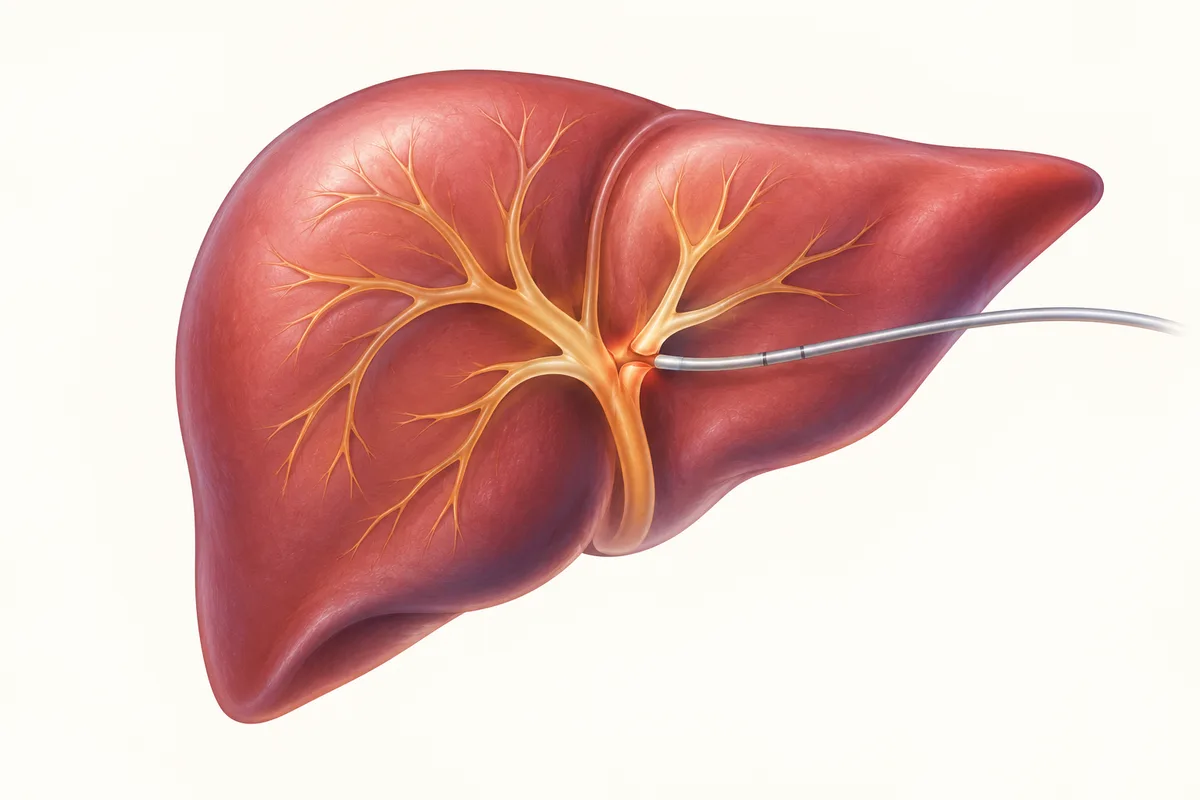
The liver makes bile, which drains through the bile ducts into the bowel. If a duct is blocked, bile backs up into the blood, causing yellow eyes and skin, dark urine, pale stools and itching. Blockages come from tumours of the pancreas, bile ducts or gallbladder, from gallstones in the duct, or from narrowings (strictures) after surgery or inflammation. An infected blocked duct (cholangitis) causes fever and chills and is urgent.
What PTBD is
In PTBD, a thin needle is passed through the skin into a bile duct inside the liver under ultrasound and X-ray, and a drainage tube is placed. Bile then drains into a bag (external drain), or past the blockage into the bowel (internal-external drain), or a permanent metal stent is placed to hold the duct open. It is done by an interventional radiologist under local anaesthetic with sedation [1].
When drainage helps and when it should wait
Drainage is used for cholangitis, for severe itching or very high bilirubin, for palliation when a blockage cannot be removed, and when ERCP is not possible or has failed. Routine drainage before every operation is not advised. In a randomised trial of 202 patients with pancreatic head cancer, routine preoperative drainage (mostly by an endoscopic stent) gave serious complications in 74% against 39% with early surgery alone, so doctors drain when there is a clear reason [2].
van der Gaag et al., N Engl J Med 2010, 202 patients [2].
How it is done
PTBD usually takes about 60 to 90 minutes.
- Blood tests, including clotting, are checked and antibiotics are given.
- You lie on your back. Ultrasound and X-ray show the bile ducts. The skin and liver surface are numbed, with sedation.
- A fine needle enters a bile duct, and contrast dye outlines the blockage.
- A guidewire crosses the blockage if possible, and a drainage tube is placed. A metal stent may be placed in the same or a later session.
- The tube is secured to the skin and connected to a bag, and care instructions are given.
Living with the drain
You will be taught the care steps, which usually include these.
- Keep the dressing clean and dry, and keep the bag below the liver.
- Flush the tube with saline as taught, to avoid blockage.
- Record the daily amount of bile, and drink enough fluid.
- Call for fever with chills, leakage around the tube, a tube that falls out, bleeding or yellowing that returns.
Risks
Risks include infection of the bile (cholangitis) or blood, bleeding, bile leaking into the abdomen, and the tube blocking or moving. Biliary procedures are in the higher bleeding risk group, so blood tests and blood thinners are managed beforehand [3]. The team explains these before you consent.
Cost and insurance
Health insurance can cover these procedures, subject to your policy terms. The exact cost is calculated after consultation, a complete evaluation of the problem, and a decision on the procedure that suits you. Cashless treatment can be arranged with major Indian health insurers and TPAs, and credit treatment is available for CGHS and Singareni beneficiaries. Eligibility is confirmed after a policy check.
Frequently asked questions
- Is PTBD painful?
- The skin and liver surface are numbed and sedation is given. You may feel pressure, and some soreness around the tube afterwards, treated with pain relief.
- How long does the drain stay?
- Until the blockage is treated, which could be days before surgery or months if it is a long-term palliative drain. Tubes are changed regularly.
- PTBD or ERCP?
- ERCP, done through the mouth by an endoscopist, is often tried first. PTBD is used when ERCP is not possible, has failed, or the blockage is high in the liver.
- Will the jaundice go away after PTBD?
- Bilirubin and itching usually fall over days to weeks, as long as the drain works. The cause of the blockage still needs treatment.
- Does drainage have to be done before surgery?
- Not routinely. Trial evidence in pancreatic head cancer shows routine drainage raised complications, so it is reserved for infection, very high bilirubin or delays [2].
References
- Saad WE, Wallace MJ, Wojak JC, Kundu S, Cardella JF. Quality improvement guidelines for percutaneous transhepatic cholangiography, biliary drainage, and percutaneous cholecystostomy. J Vasc Interv Radiol. 2010;21(6):789-795. Read the source
- van der Gaag NA, Rauws EA, van Eijck CH, et al. Preoperative biliary drainage for cancer of the head of the pancreas. N Engl J Med. 2010;362(2):129-137. Read the source
- Patel IJ, Rahim S, Davidson JC, et al. Society of Interventional Radiology Consensus Guidelines for the Periprocedural Management of Thrombotic and Bleeding Risk in Patients Undergoing Percutaneous Image-Guided Interventions, Part II: Recommendations. J Vasc Interv Radiol. 2019;30(8):1168-1184. Read the source
Want to discuss your options?
Speak with the Clinic Seven team.