Patient guide
Image-guided biopsy and drainage procedures: a complete patient guide
A plain-language guide to needle biopsies (FNAC, core or Trucut, ultrasound and CT guided) and drainage procedures (fluid tapping, pigtail catheters, abscess drainage) done by an interventional radiologist in Hyderabad.
Why these are done by image guidance
- No operationA needle or thin tube through the skin
- Local anaestheticNumbing in most cases
- Often day-careMany go home the same day
- Placed under live imagingThe doctor sees the needle tip
- Quick proceduresMany take well under an hour
- Clear answersA diagnosis or relief of symptoms


What image-guided means
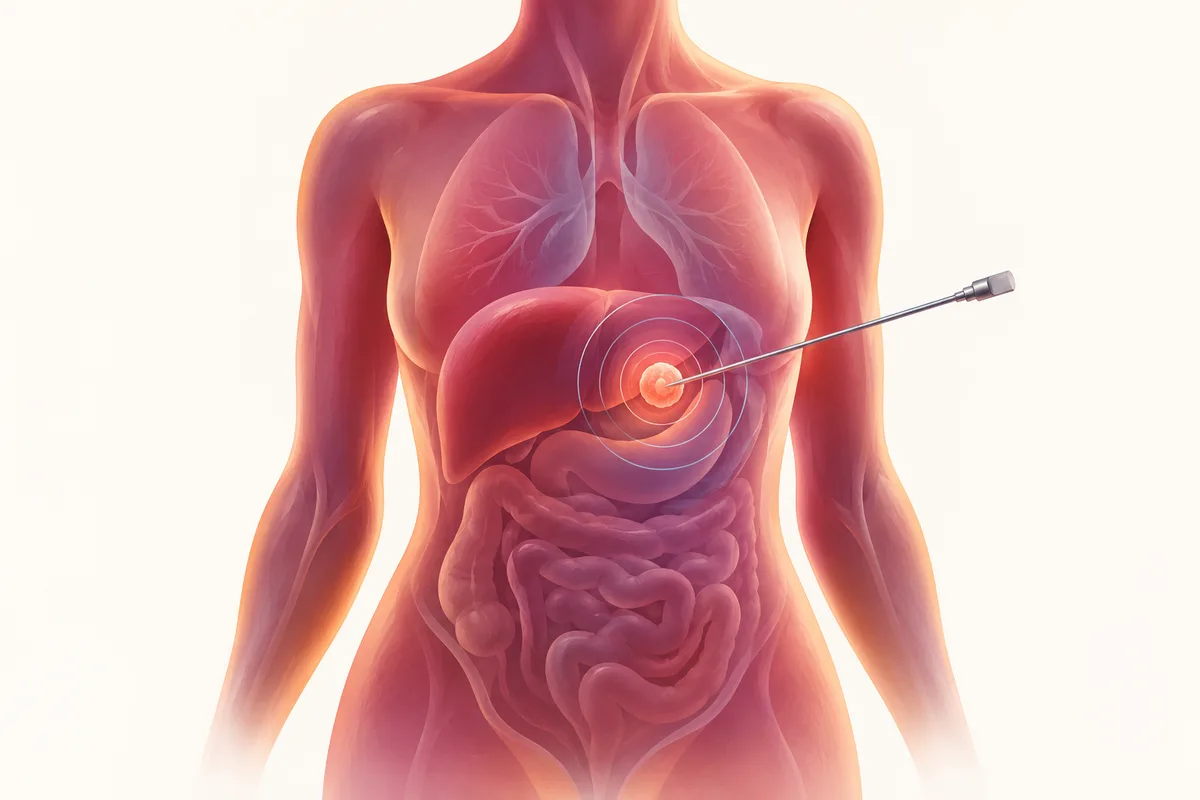
An interventional radiologist uses imaging, usually ultrasound, CT or X-ray fluoroscopy, to guide a needle or a thin tube to the exact spot that needs sampling or draining. Because the tip is visible on the screen throughout, the procedure can be done through a small puncture in the skin, often with only local anaesthetic.
There are two broad groups. Biopsies take a sample of cells or tissue to find out what a lump, nodule, shadow or enlarged gland is. Drainage procedures remove fluid, pus or blocked secretions, either as a single tap or by leaving a thin catheter in place for a few days.
Biopsy types compared
Four names come up again and again. Two describe the needle (FNAC and core biopsy) and two describe the imaging used (ultrasound guided and CT guided). Any needle can be guided by either, depending on where the target lies.
| FNAC | Core (Trucut) biopsy | Ultrasound guided | CT guided | |
|---|---|---|---|---|
| What it is | Very fine needle, loose cells | Wider needle, a thin core of tissue | Needle watched on live ultrasound | Needle guided on CT slices |
| What it gives | Cells for the cytology report | Tissue, so structure and special stains can be studied | Sampling from lumps and organs ultrasound can see | Sampling from deep or hidden areas such as lung or abdomen |
| Typical targets | Thyroid, neck glands, breast lumps | Breast, glands, liver, kidney, masses | Thyroid, breast, neck, liver, kidney, soft tissue | Lung, mediastinum, bone, pancreas, retroperitoneum |
Drainage procedures compared
Drainage is chosen according to what is collecting, where, and how fast it returns.
| Fluid tapping (paracentesis, thoracentesis) | Pigtail catheter | Abscess drainage | Nephrostomy or biliary drainage | |
|---|---|---|---|---|
| What it is | A needle removes fluid in one sitting | A thin curled catheter stays for days | A catheter is placed into the pus pocket | A tube drains a blocked kidney or bile duct |
| Used for | Fluid in the abdomen or chest | Fluid that keeps coming back, pleural infection, collections | Liver, abdominal, pelvic and other abscesses | Obstructed kidney, jaundice from blocked bile ducts |
| Stay | Usually day-care | Days with the tube in | Days with the tube in | Weeks to months, then reviewed |
Which procedure for which problem
These are the usual starting points. Your own scans and reports decide the final choice.
| Problem | Procedure usually considered |
|---|---|
| Thyroid nodule or neck lump | Ultrasound-guided FNAC or core biopsy |
| Breast lump | Ultrasound-guided core biopsy |
| Lung nodule or shadow | CT-guided biopsy |
| Fluid in the abdomen (ascites) | Ascitic fluid tapping, sometimes with a drain |
| Fluid around the lung | Pleural fluid tapping or a pigtail catheter |
| Liver abscess or other abscess | Image-guided abscess drainage, with antibiotics |
| Blocked, infected kidney | Percutaneous nephrostomy |
| Jaundice from a blocked bile duct | Biliary drainage (PTBD) or stenting |
Safety and preparation
Bleeding is the main thing to plan around. Simple procedures such as fluid tapping and biopsies of superficial structures are generally low bleeding risk, while deep organ biopsies, kidney and bile duct drainage and deep abscess drainage are higher risk and may need blood test limits and a plan for blood thinners [1]. Never stop a blood thinner on your own; your doctor will tell you what to do and when.
- Tell the team about every medicine, especially blood thinners, aspirin, clopidogrel and diabetes medicines.
- Bring your latest scans, films and reports, and recent blood tests if you have them.
- You may be asked to fast for a few hours, and to bring an adult with you.
- You will be asked to sign a consent form after the risks, benefits and alternatives are explained.
After the procedure
Most people are watched for a short time and then go home the same day. A drain or catheter stays for days and comes with instructions for caring for it. Tissue and fluid samples go to the laboratory, and reports take from a day or two for simple tests to about a week when special stains are needed.
Call the clinic or go to an emergency department for fever with chills, bleeding that does not stop, severe or worsening pain, breathlessness, or a drain that falls out or blocks.
What these procedures cannot do
A biopsy gives a diagnosis; it is not a treatment. Drainage relieves fluid or pus, but the cause (a tumour, an infection, a blocked duct) still has to be treated. Some problems need surgery or another specialist, and an honest assessment will say so. If you have been advised an operation, a biopsy or drainage may still be the right first step, so ask what it will add to the decision.
Cost and insurance
Health insurance can cover these procedures, subject to your policy terms. The exact cost is calculated after consultation, a complete evaluation of the problem, and a decision on the procedure that suits you. Cashless treatment can be arranged with major Indian health insurers and TPAs, and credit treatment is available for CGHS and Singareni beneficiaries. Eligibility is confirmed after a policy check.
Frequently asked questions
- Is an image-guided biopsy painful?
- The skin and tissue along the needle path are numbed with local anaesthetic. You may feel pressure and a brief pinch, and a core biopsy can have a clicking sound. Most people describe it as uncomfortable rather than painful.
- Do I need to be admitted?
- Many biopsies and fluid taps are day-care. Drains, kidney or bile duct procedures and infected collections usually need a short stay. Your consultation confirms this for your case.
- How long do biopsy results take?
- Simple cytology reports often take a day or two. Tissue biopsies take longer, and special stains can add several days. The laboratory gives the timeline when the sample is sent.
- Should I stop my blood thinners before a biopsy?
- Do not stop them yourself. Whether and when to pause them depends on the procedure's bleeding risk and why you take them, and your doctor will give clear instructions [1].
- How do I book a biopsy or drainage procedure in Hyderabad?
- Send your scans and reports to Clinic Seven on WhatsApp at +91 91145 91105, or book a consultation. Dr. Nagateja Bonala reviews them and explains which procedure is needed.
References
- Patel IJ, Rahim S, Davidson JC, et al. Society of Interventional Radiology Consensus Guidelines for the Periprocedural Management of Thrombotic and Bleeding Risk in Patients Undergoing Percutaneous Image-Guided Interventions, Part II: Recommendations. J Vasc Interv Radiol. 2019;30(8):1168-1184. Read the source
Want to discuss your options?
Speak with the Clinic Seven team.