Patient guide
Core needle biopsy (Trucut): what it is and how it differs from FNAC
What a core needle biopsy or Trucut biopsy is, how it differs from FNAC, what the studies show on accuracy, what it feels like, the risks, and how long results take.
Core biopsy at a glance
- A tissue sampleNot just loose cells
- Local anaestheticYou stay awake
- A needle-sized punctureNo stitches
- Usually day-careHome the same day
- Image-guidedUltrasound or CT shows the needle
- More detailSpecial stains can be done

What a core needle biopsy is
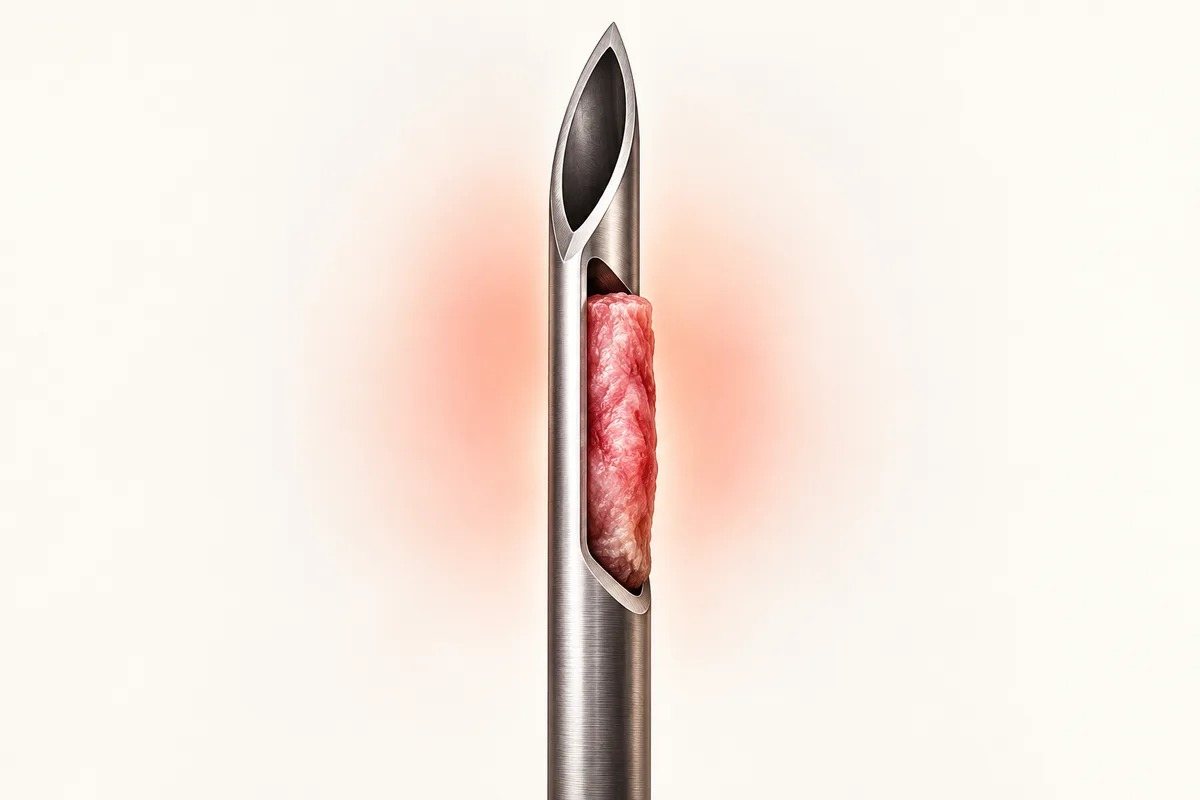
A core needle biopsy uses a hollow needle, often spring-loaded, to cut a thin cylinder of tissue about the length of a few millimetres to a couple of centimetres. It is done through the skin under local anaesthetic and image guidance. The name Trucut comes from an early needle design, and today the terms core biopsy, Trucut biopsy and core needle biopsy are used for the same kind of test.
Because a core is solid tissue, the pathologist can see the architecture, how cells sit together and invade, and run special stains that tell the exact type of disease.
Core biopsy compared with FNAC
FNAC and core biopsy answer different questions, and one does not replace the other in every case.
| FNAC | Core needle biopsy | |
|---|---|---|
| Needle | Very fine, similar to an injection needle | Wider needle that cuts a thin core |
| Sample | Loose cells | Solid tissue |
| Can show tissue pattern | No | Yes |
| Special stains | Limited | Wide range (immunohistochemistry) |
| Time and discomfort | Quicker, least discomfort | A little longer, mildly more discomfort |
| Bleeding | Very low | Slightly higher |
What the studies show
In a 2026 prospective study, 285 patients with an abnormal superficial lymph node had both a core biopsy and an FNA of the same node. Core biopsy gave an adequate sample in 97.9% against 94.0% for FNA, with higher sensitivity (96.2% against 90.4%) and accuracy (97.0% against 92.5%). FNA was quicker, and core biopsy carried a higher bleeding risk [2]. In suspected breast cancer, a study of 140 patients found that core biopsy detected nodal spread in 95.5% against 67.2% for FNA, with mildly more pain [3].
Zhao et al., Acad Radiol 2026, 285 patients, same lymph node sampled both ways [2].
What it feels like and how it is done
The procedure is the same as an ultrasound- or CT-guided biopsy, with a core needle.
- You lie in position, the skin is cleaned and the area is numbed with local anaesthetic.
- The needle is guided to the target on ultrasound or CT.
- The spring-loaded needle is fired to take the core. You hear a click and feel a brief thump or pressure.
- Two to four cores are usually taken from the lesion.
- Pressure is held and a small dressing is placed. You rest briefly and go home, usually the same day.
Risks and what to do after
The commonest effects are bruising and local soreness. Bleeding is a little more likely than with FNAC and is planned around with blood tests and medicine instructions [1, 2]. Rare problems include infection or injury to a nearby structure, and deeper biopsies carry more risk than superficial ones. Keep the dressing dry, avoid heavy lifting for the period advised, and call if you have swelling, fever, bleeding or worsening pain.
Results and the next step
Tissue is processed in the laboratory. A first report often takes a few days, and special stains can add several more. Your doctor reviews the report with you and explains what it means and what is next. If the first sample is not enough, a repeat biopsy may be suggested.
Cost and insurance
Health insurance can cover these procedures, subject to your policy terms. The exact cost is calculated after consultation, a complete evaluation of the problem, and a decision on the procedure that suits you. Cashless treatment can be arranged with major Indian health insurers and TPAs, and credit treatment is available for CGHS and Singareni beneficiaries. Eligibility is confirmed after a policy check.
Frequently asked questions
- What is a Trucut biopsy?
- Trucut is the name of an early cutting needle. A Trucut biopsy is now a common name for a core needle biopsy, in which a thin cylinder of tissue is taken through a needle.
- Is core biopsy better than FNAC?
- It gives more information and, in studies of lymph nodes, was more sensitive [2, 3]. FNAC is quicker and has less bleeding risk. The choice depends on the target and the question being asked.
- Does a core biopsy hurt?
- The area is numbed first. You may feel pressure and a click. Mild soreness can last a day or two.
- Can a core biopsy be done without ultrasound or CT?
- For most internal lumps, image guidance is the safer and more accurate way to place the needle, and it is the standard approach for interventional radiology.
- How many samples are taken?
- Usually two to four cores, depending on the lesion and what tests are needed.
References
- Patel IJ, Rahim S, Davidson JC, et al. Society of Interventional Radiology Consensus Guidelines for the Periprocedural Management of Thrombotic and Bleeding Risk in Patients Undergoing Percutaneous Image-Guided Interventions, Part II: Recommendations. J Vasc Interv Radiol. 2019;30(8):1168-1184. Read the source
- Zhao Q, Meng Q, Wang Z. Diagnostic performance and operator workload of core needle biopsy versus fine-needle aspiration for superficial lymph nodes: a prospective, paired comparative study. Acad Radiol. 2026;33(8):3425-3435. Read the source
- Winkler N, Buxton J, Freer P, et al. Comparison of diagnostic sensitivity and procedure-related pain of concurrent ultrasound-guided fine-needle aspiration and core-needle biopsy of axillary lymph nodes in patients with suspected or known breast cancer. J Breast Imaging. 2023;5(4):436-444. Read the source
Want to discuss your options?
Speak with the Clinic Seven team.