Patient guide
FNAC test: procedure, preparation, results and limits
What an FNAC (fine needle aspiration cytology) test is, how it is done, what it is used for (thyroid, neck glands, breast lumps), how thyroid results are reported, and when a core biopsy is better.
FNAC at a glance
- A few minutesOften under 10 minutes
- A fine needleAbout as thin as an injection
- No stitchesA plaster is enough
- Walk in, walk outNo hospital stay
- Image-guided if neededUltrasound shows the needle
- Quick resultsOften within a day or two

What FNAC is
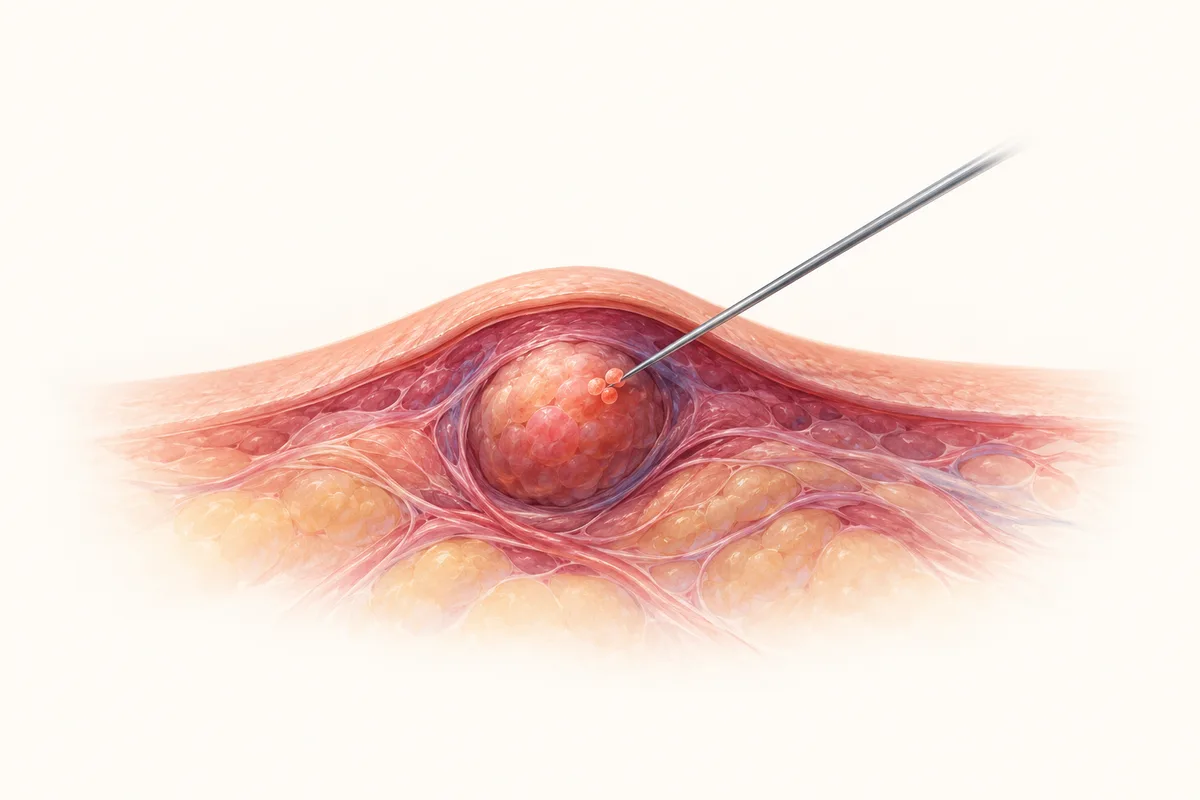
FNAC stands for fine needle aspiration cytology. A very thin needle is passed into a lump and moved gently back and forth so that a few cells are drawn into it. The cells are smeared on slides, stained and examined under the microscope by a cytopathologist.
Because the needle is so fine, anaesthetic is often not needed, the test takes only a few minutes, and the risk of complications is very low. When the lump cannot be felt, or lies close to important structures, it is done with ultrasound guidance so the needle goes to the right place.
What FNAC is used for
FNAC is the usual first test for many accessible lumps.
- Thyroid nodules, to separate benign nodules from ones that need further work-up or surgery.
- Enlarged neck glands (lymph nodes), to look for infection such as tuberculosis, spread of cancer or lymphoma.
- Breast lumps and armpit glands.
- Salivary gland swellings and lumps under the skin.
- Fluid collections and cysts, which can be sampled and sometimes drained at the same time.
How the test is done
The test is brief and rarely needs preparation.
- You lie or sit in the position that gives the best access to the lump. The skin is cleaned.
- For small or deep lumps, ultrasound is used to guide the needle.
- The needle is passed into the lump and moved back and forth a few times. You may feel a pinch or pressure.
- The cells are spread on slides. Sometimes the sample is checked straight away to confirm it is adequate, and a second pass is taken if not.
- Pressure is held for a few minutes and a small plaster is placed.
Reading the result: thyroid and other lumps
Thyroid FNAC reports use the Bethesda System, which sorts results into six categories: non-diagnostic, benign, atypia of undetermined significance, follicular neoplasm, suspicious for malignancy, and malignant. Each category carries a recommended next step, such as repeat FNAC, follow-up, a molecular test, or surgery [1].
A report from a lymph node may show a reactive node, infection (including tuberculosis), spread of cancer or a suspicion of lymphoma. A report that is not definite is not a failure of the test; it tells you the next step, which may be a core biopsy.
Limits, and when a core biopsy is better
FNAC gives cells but not the pattern of the tissue. Some samples have too few cells (non-diagnostic), and some diagnoses, such as lymphoma subtyping or breast receptor tests, are better made on tissue. In a 2026 study of 285 lymph nodes sampled both ways, core biopsy gave an adequate sample more often (97.9% against 94.0%) and was more sensitive (96.2% against 90.4%) [2]. In suspected breast cancer, core biopsy found nodal spread in 95.5% against 67.2% for FNA [3]. FNA was quicker and has less bleeding risk.
After the test
You can usually resume normal activity straight away. A small bruise or tenderness is common. Call if there is swelling that increases, fever or bleeding. Reports often come within a day or two, depending on the laboratory, and your doctor explains them and the next step.
Cost and insurance
Health insurance can cover these procedures, subject to your policy terms. The exact cost is calculated after consultation, a complete evaluation of the problem, and a decision on the procedure that suits you. Cashless treatment can be arranged with major Indian health insurers and TPAs, and credit treatment is available for CGHS and Singareni beneficiaries. Eligibility is confirmed after a policy check.
Frequently asked questions
- Is FNAC painful?
- Most people feel a pinch or pressure for a few seconds. The needle is very thin, and anaesthetic is often not needed.
- Does FNAC spread cancer?
- Needle-track spread is described but very uncommon. The information gained from knowing what the lump is far outweighs this, and your doctor weighs it for your case.
- What does 'non-diagnostic' mean on a thyroid FNAC?
- It means too few cells were collected for a firm answer. Repeating the test, often with ultrasound guidance, usually gives a diagnostic result [1].
- How accurate is FNAC?
- It is very useful for many lumps, but it is a cell test with limits. Core biopsy was more sensitive for lymph nodes in recent studies [2, 3], which is why it is advised when tissue is needed.
- Do I need to fast or stop medicines for FNAC?
- Usually not. Tell the team about blood thinners, and do not stop any on your own.
References
- Cibas ES, Ali SZ. The 2017 Bethesda System for Reporting Thyroid Cytopathology. Thyroid. 2017;27(11):1341-1346. Read the source
- Zhao Q, Meng Q, Wang Z. Diagnostic performance and operator workload of core needle biopsy versus fine-needle aspiration for superficial lymph nodes: a prospective, paired comparative study. Acad Radiol. 2026;33(8):3425-3435. Read the source
- Winkler N, Buxton J, Freer P, et al. Comparison of diagnostic sensitivity and procedure-related pain of concurrent ultrasound-guided fine-needle aspiration and core-needle biopsy of axillary lymph nodes in patients with suspected or known breast cancer. J Breast Imaging. 2023;5(4):436-444. Read the source
Want to discuss your options?
Speak with the Clinic Seven team.