Patient guide
Image-guided abscess drainage: how it works, aftercare and when surgery is needed
How an abscess is drained through a needle or catheter under ultrasound or CT, what to expect, the catheter's aftercare, success and failure, and when surgery is still needed.
Image-guided drainage at a glance
- No open surgeryA thin tube through the skin
- Local anaestheticWith sedation if needed
- Ultrasound or CT guidedThe pocket is targeted exactly
- Under an hourFor most drainages
- Culture sampleGuides the right antibiotic
- Short stayOften a few days




What an abscess is, and why it needs draining
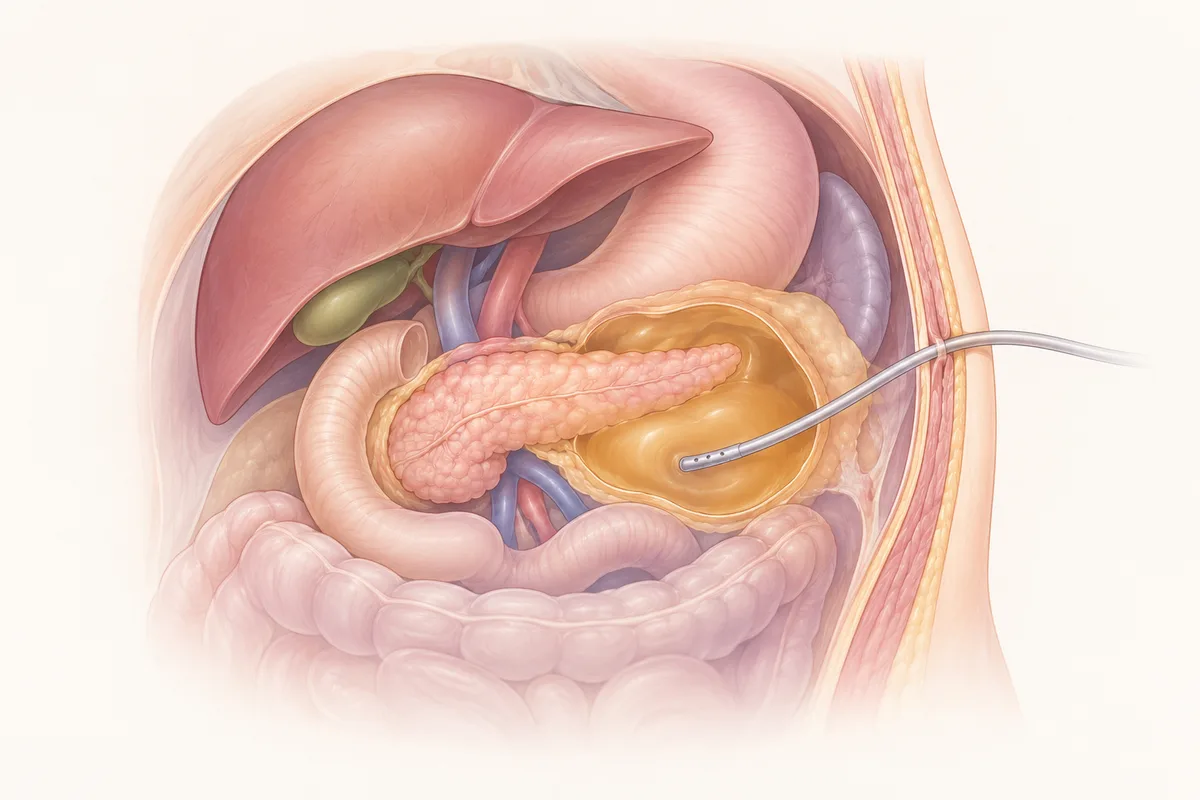
An abscess is a walled-off collection of pus that forms when an infection cannot be cleared. It can be in the liver, the abdomen or pelvis (after surgery, appendicitis, diverticulitis or Crohn's disease), around the kidney, in muscle, or in the lung or chest. Pus is thick and has a poor blood supply, so antibiotics reach it poorly. Draining it removes the infection, relieves pain and fever, and lets the antibiotic work [1].
How the decision is made
Ultrasound or CT shows the size, position and contents of the collection. The interventional radiologist plans a safe route that avoids the bowel, blood vessels and lungs. A collection that is still solid (phlegmon) or has no safe path may not be drainable, and in that case antibiotics, another approach or surgery are considered.
How it is done
Most drainages take about 30 to 60 minutes.
- Blood tests and any antibiotics are arranged first. The route is planned on imaging.
- The skin is numbed with local anaesthetic, with sedation if needed.
- A needle enters the abscess, and pus is sent for culture.
- A guidewire is passed, the track is widened and a pigtail catheter is placed in the cavity. The cavity is emptied and may be washed with saline.
- The catheter is secured and attached to a bag. A scan checks the position.
Aftercare and removal
The catheter is flushed as instructed, and the amount of pus is recorded. Antibiotics are continued, and the choice is adjusted by the culture result. A repeat scan checks that the cavity has collapsed. The catheter is removed when the drainage has fallen, the fever has gone and the scan looks better. Call for fever, a tube that blocks or falls out, bleeding or increasing pain.
Success, failure and when surgery is needed
Many abscesses settle with drainage and antibiotics. Drainage can fail when the pus is very thick, the abscess has several compartments, or the cause continues, such as a hole in the bowel or an infected foreign body. A second catheter, a clot-dissolving medicine through the drain, or surgery may then be needed. Percutaneous drainage may also be used first to treat the infection so that a later operation is safer.
Risks
Risks include bleeding, a brief spike of infection (sepsis) during drainage, injury to a nearby organ, a tube that blocks or moves, and a wound infection at the site. Deep drainages are a higher bleeding risk group, so blood tests and blood thinners are managed beforehand [2]. The team will explain these to you before you consent.
Cost and insurance
Health insurance can cover these procedures, subject to your policy terms. The exact cost is calculated after consultation, a complete evaluation of the problem, and a decision on the procedure that suits you. Cashless treatment can be arranged with major Indian health insurers and TPAs, and credit treatment is available for CGHS and Singareni beneficiaries. Eligibility is confirmed after a policy check.
Frequently asked questions
- Can an abscess be treated with antibiotics alone?
- Small abscesses sometimes can, but most larger ones need drainage because antibiotics reach pus poorly [1]. Your doctor decides from your scan.
- Is abscess drainage painful?
- The area is numbed. You may feel pressure, and the catheter can be sore afterwards. Pain relief is given.
- How long does the drain stay?
- Usually several days to a couple of weeks, until the drainage is small and the scan shows the cavity has closed.
- Will I need surgery after the drain?
- Often not, but some abscesses need surgery if the cause (for example a perforation) needs repair or drainage fails.
- Can any abscess be drained this way?
- No. A collection must be liquid and have a safe path. Your doctor reviews the scan and explains.
References
- Wallace MJ, Chin KW, Fletcher TB, et al. Quality improvement guidelines for percutaneous drainage/aspiration of abscess and fluid collections. J Vasc Interv Radiol. 2010;21(4):431-435. Read the source
- Patel IJ, Rahim S, Davidson JC, et al. Society of Interventional Radiology Consensus Guidelines for the Periprocedural Management of Thrombotic and Bleeding Risk in Patients Undergoing Percutaneous Image-Guided Interventions, Part II: Recommendations. J Vasc Interv Radiol. 2019;30(8):1168-1184. Read the source
Want to discuss your options?
Speak with the Clinic Seven team.