Patient guide
Liver abscess drainage: amoebic vs pyogenic, and when drainage is needed
How a liver abscess is treated: amoebic and pyogenic abscess compared, when ultrasound-guided drainage is needed, aspiration versus catheter, what the evidence shows and aftercare.
Liver abscess drainage at a glance
- No open surgeryA needle or thin catheter
- Local anaestheticWith sedation if needed
- Ultrasound guidedPus is drained precisely
- Faster recoveryFever and pain settle sooner
- A short stayOften a few days
- Antibiotics continueAlongside drainage




What a liver abscess is
A liver abscess is a collection of pus within the liver, causing fever, right upper abdominal pain, tiredness and sometimes jaundice. It can arise from bacteria spreading from the bowel or bile ducts (pyogenic abscess, more likely in people with diabetes or bile duct disease) or from the amoeba Entamoeba histolytica, usually after contaminated food or water (amoebic abscess). Ultrasound or CT confirms it, and blood tests and the type of pus help separate the types.
Amoebic and pyogenic abscess compared
The type decides how much depends on drainage.
| Amoebic liver abscess | Pyogenic liver abscess | |
|---|---|---|
| Cause | Amoeba, from contaminated food or water | Bacteria from the bowel, bile ducts or blood |
| Main medicine | Metronidazole, followed by a luminal agent | Intravenous antibiotics, then oral, guided by culture |
| Is drainage needed? | Not always. Used for large or high-risk abscesses, or if no response | Usually, together with antibiotics |
| Pus | Often thick, brownish | Yellow-green, often smelly |
When drainage is advised
Your doctor decides from your scan and how you are responding.
- A large abscess, or one with a thin rim of liver around it that could rupture.
- An abscess in the left lobe, because rupture there can reach the sac around the heart.
- An amoebic abscess that has not improved after a few days of medicine.
- Pyogenic abscess, where drainage is the standard together with antibiotics.
- Uncertainty about the diagnosis, where the pus needs testing.
Needle aspiration or a catheter?
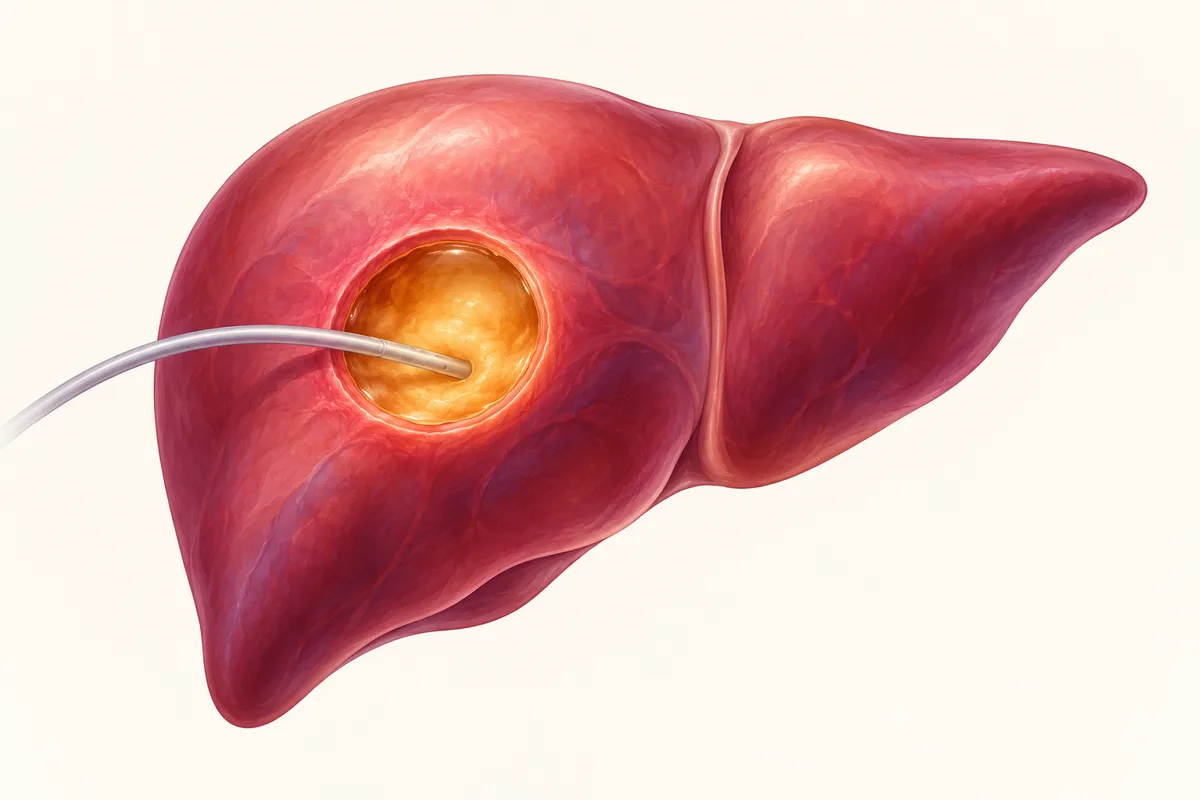
Under ultrasound, the pus can be removed with a needle (aspiration), sometimes repeated, or by leaving a pigtail catheter in the cavity for a few days. A meta-analysis of 10 randomised trials with 1,287 patients found catheter drainage was more successful than needle aspiration (risk ratio 1.16), with the benefit clearest for large abscesses, improved clinical outcomes by about 3 days and 4 fewer days of intravenous antibiotics [1].
For amoebic abscess, a randomised study in Indian patients compared metronidazole alone with metronidazole plus needle aspiration. Fever, tenderness and cavity size fell faster with aspiration, especially in abscesses of 5 to 10 cm, with no major complications [2].
How it is done
Plan around 30 to 60 minutes.
- Blood tests, including clotting and platelets, are checked, and antibiotics are started.
- Ultrasound marks the best path into the abscess, avoiding vessels and the lung.
- The skin and liver capsule are numbed with local anaesthetic, with sedation if needed.
- Pus is removed and sent for culture. A catheter is left in if planned, secured and attached to a bag.
- The catheter is flushed as instructed and removed when drainage has fallen and the scan looks better.
Risks and warning signs
Risks include bleeding, leakage of pus into the abdomen or chest, infection spreading to the blood, a blocked or displaced catheter, and rare injury to nearby organs. Liver procedures are a higher bleeding risk group, so clotting tests and blood thinners are managed beforehand [3]. Call at once for worsening pain, high fever, breathlessness, bleeding or a tube that falls out.
Cost and insurance
Health insurance can cover these procedures, subject to your policy terms. The exact cost is calculated after consultation, a complete evaluation of the problem, and a decision on the procedure that suits you. Cashless treatment can be arranged with major Indian health insurers and TPAs, and credit treatment is available for CGHS and Singareni beneficiaries. Eligibility is confirmed after a policy check.
Frequently asked questions
- Does every liver abscess need drainage?
- No. Many amoebic abscesses settle with medicine alone, while pyogenic abscesses usually need drainage. Large, left-lobe or non-responding abscesses are drained [2].
- Is catheter drainage better than needle aspiration?
- In pooled trials of pyogenic liver abscess, catheter drainage had a higher success rate, especially for large abscesses [1]. The choice depends on size, thickness and your response.
- How long does recovery take?
- Fever and pain often improve within days after drainage. Antibiotics usually continue for longer, and your doctor sets the course.
- Can a liver abscess burst?
- Yes, into the abdomen, chest or the sac around the heart, which is why large or left-lobe abscesses are watched closely and often drained.
- Is the drain painful?
- The area is numbed for the procedure, and you may feel soreness around the tube, treated with pain relief.
References
- Lin JW, Chen CT, Hsieh MS, et al. Percutaneous catheter drainage versus percutaneous needle aspiration for liver abscess: a systematic review, meta-analysis and trial sequential analysis. BMJ Open. 2023;13(7):e072736. Read the source
- Ghosh JK, Goyal SK, Behera MK, et al. Efficacy of aspiration in amebic liver abscess. Trop Gastroenterol. 2015;36(4):251-255. Read the source
- Patel IJ, Rahim S, Davidson JC, et al. Society of Interventional Radiology Consensus Guidelines for the Periprocedural Management of Thrombotic and Bleeding Risk in Patients Undergoing Percutaneous Image-Guided Interventions, Part II: Recommendations. J Vasc Interv Radiol. 2019;30(8):1168-1184. Read the source
Want to discuss your options?
Speak with the Clinic Seven team.