Patient guide
Pigtail catheter drainage: what it is, how long it stays and how to care for it
What a pigtail catheter is, when it is used (pleural fluid, empyema, abscess, collections), how it is placed under imaging, how to care for it, how long it stays, and the evidence in pleural infection.
Pigtail drainage at a glance
- No operationA thin tube through the skin
- Local anaestheticYou stay awake
- Placed under imagingUltrasound, CT or X-ray
- A few daysThe tube stays only as needed
- Under an hourTo place the catheter
- Relief of symptomsBreathing or pain eases




What a pigtail catheter is
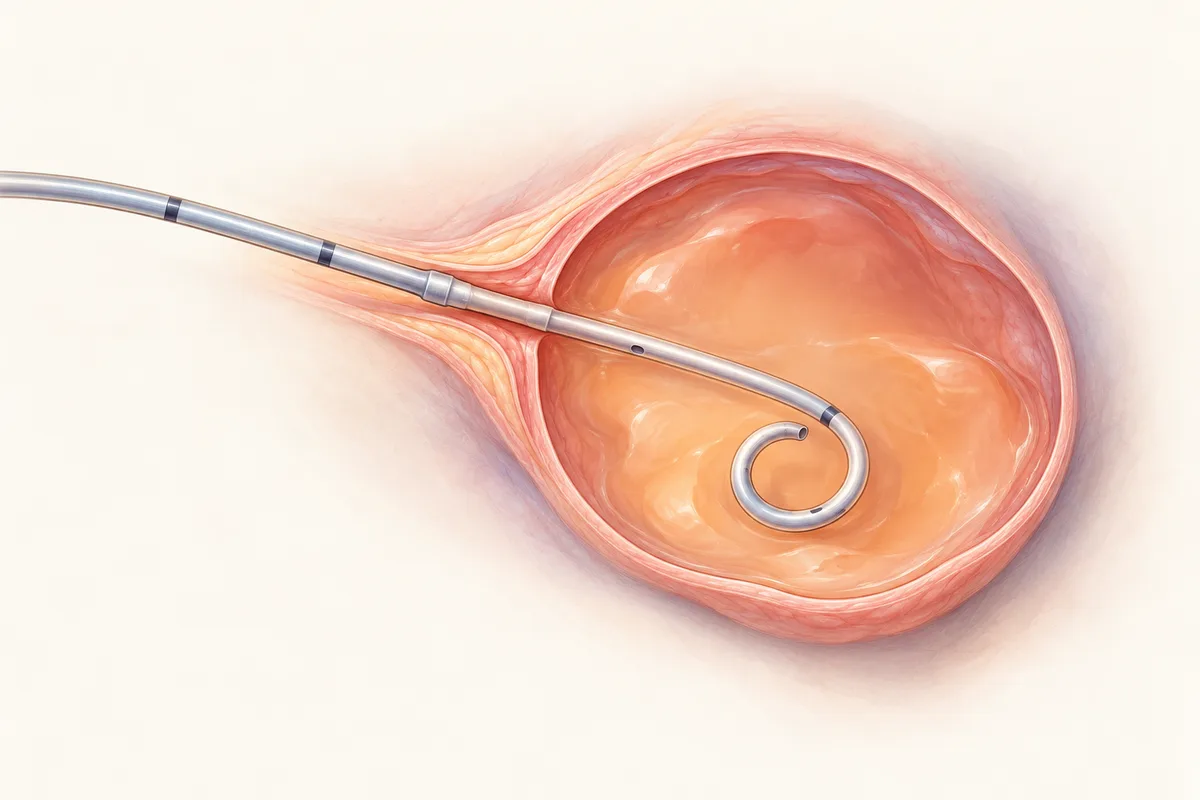
A pigtail catheter is a soft tube, usually 8 to 14 French (about 2.7 to 4.7 mm) wide, whose tip curls back on itself like a pig's tail. The curl stops it from slipping out of the collection it is draining. It connects to a drainage bag or a one-way valve, and can stay in for days.
It is placed by an interventional radiologist using ultrasound, CT or X-ray, so the tip lands exactly in the fluid, air or pus.
Where pigtail catheters are used
A pigtail catheter can drain many types of collections.
| Problem | What the catheter does |
|---|---|
| Pleural effusion that returns | Drains fluid from around the lung over days |
| Pleural infection (empyema) | Drains infected fluid, often with antibiotics and clot-busting medicine [2] |
| Pneumothorax | Removes air and lets the lung re-expand |
| Abscess or infected collection | Drains pus until the cavity collapses |
| Ascites that returns | Short-term drainage, or a tunnelled version for home drainage |
How the catheter is placed
Placement usually takes 30 to 45 minutes.
- Imaging marks the safest route into the collection. The skin is cleaned and numbed.
- A thin needle enters the collection, and a guidewire is passed through it.
- The track is widened slightly and the pigtail catheter is slid over the wire. The tip curls up inside the collection.
- The catheter is stitched or secured to the skin and attached to a bag or valve. A dressing covers it.
- A scan or X-ray checks the position. You are shown how to care for the tube.
Living with the catheter
You will be given specific instructions, and the usual points are these.
- Keep the dressing clean and dry, and avoid pulling on the tube.
- Keep the bag below the level of the catheter, and note the amount drained each day.
- Flush the catheter with saline if you have been taught to, to keep it from blocking.
- Call at once for fever, redness or pus at the site, a blocked or dislodged tube, sudden breathlessness, or drainage that stops with symptoms returning.
How long it stays, and the evidence in pleural infection
The catheter is usually removed when the drainage falls to a small amount and the scan shows the collection has resolved, which often takes days. Infected fluid in the pleural space can be thick, and a drain alone may not clear it. In the MIST2 trial of 210 patients with pleural infection, intrapleural t-PA plus DNase improved drainage on the chest X-ray and lowered the chance of referral for surgery at 3 months, 4% against 16% with placebo [2].
Rahman et al., N Engl J Med 2011, 210 patients [2].
Risks
Risks include pain at the site, bleeding, infection, blockage, the tube falling out, and rarely injury to a nearby organ or air entering the chest. Deeper drains are a higher bleeding risk group, so blood tests and blood thinners are reviewed first [3]. The team will explain these to you before you consent.
Cost and insurance
Health insurance can cover these procedures, subject to your policy terms. The exact cost is calculated after consultation, a complete evaluation of the problem, and a decision on the procedure that suits you. Cashless treatment can be arranged with major Indian health insurers and TPAs, and credit treatment is available for CGHS and Singareni beneficiaries. Eligibility is confirmed after a policy check.
Frequently asked questions
- Is a pigtail catheter painful?
- Placement is done under local anaesthetic. You may feel pressure, and the tube can be uncomfortable when you move or breathe deeply. Pain relief is provided.
- How long does a pigtail catheter stay in?
- Usually a few days, until drainage settles and imaging looks better. Pleural infection can take longer.
- Can I go home with a pigtail catheter?
- Sometimes, if the drainage is stable and you or a carer have been shown how to look after it. Otherwise a short stay is advised.
- What if the catheter blocks or falls out?
- Call the clinic at once. Do not try to push it back in. A blocked tube may be flushed or replaced, and a new one placed if needed.
- Is pigtail drainage better than a big chest tube?
- Small-bore catheters are the usual first choice for pleural drainage and are placed under imaging with less discomfort [1]. A larger tube may be used in some situations such as bleeding into the chest.
References
- Roberts ME, Rahman NM, Maskell NA, et al. British Thoracic Society Guideline for pleural disease. Thorax. 2023;78(Suppl 3):s1-s42. Read the source
- Rahman NM, Maskell NA, West A, et al. Intrapleural use of tissue plasminogen activator and DNase in pleural infection. N Engl J Med. 2011;365(6):518-526. Read the source
- Patel IJ, Rahim S, Davidson JC, et al. Society of Interventional Radiology Consensus Guidelines for the Periprocedural Management of Thrombotic and Bleeding Risk in Patients Undergoing Percutaneous Image-Guided Interventions, Part II: Recommendations. J Vasc Interv Radiol. 2019;30(8):1168-1184. Read the source
Want to discuss your options?
Speak with the Clinic Seven team.