Patient guide
Pleural fluid tapping (thoracentesis): procedure, risks and results
What pleural fluid tapping (thoracentesis) is, why ultrasound guidance matters, what the fluid tests show, how much is drained, risks including pneumothorax, and what to do if fluid returns.
Pleural tapping at a glance
- Easier breathingOften felt straight away
- Local anaestheticYou stay awake
- Ultrasound guidedThe best spot is marked
- A small punctureNo stitches
- Often day-careMany go home the same day
- Finds the causeFluid is tested

What pleural fluid tapping is
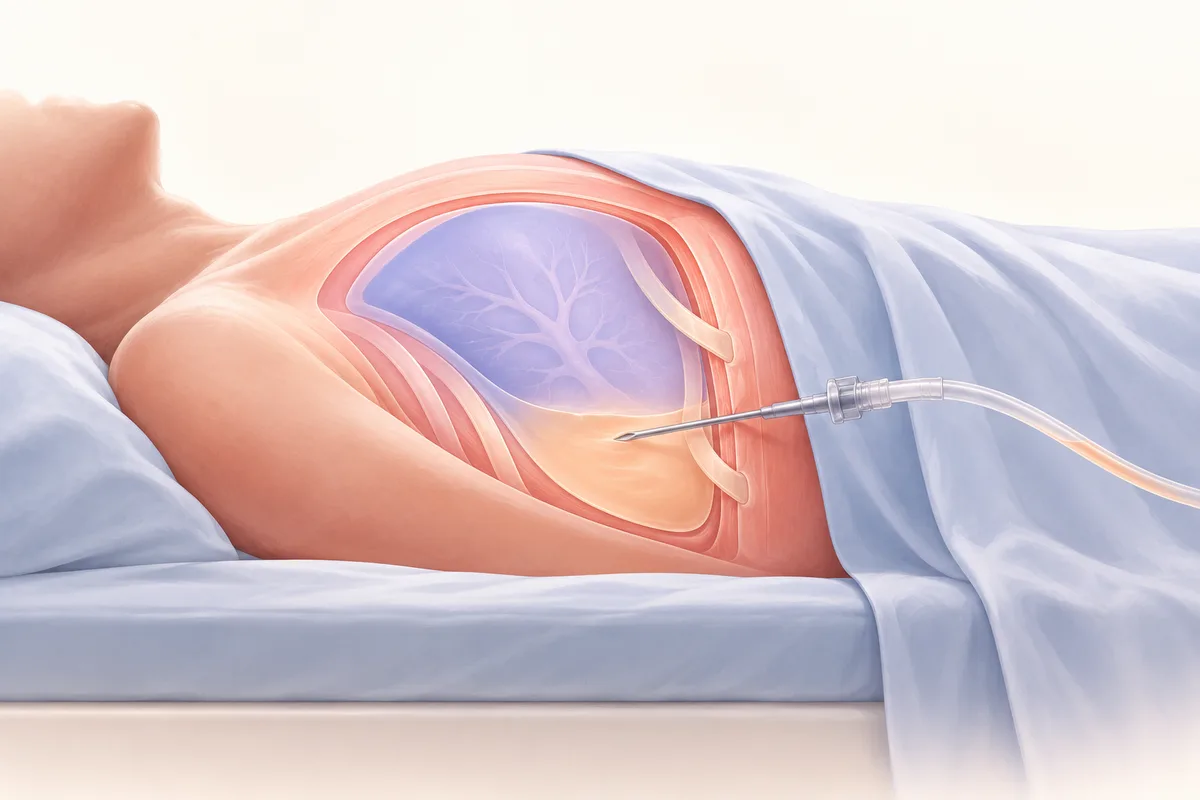
A pleural effusion is a build-up of fluid between the lung and the chest wall. It makes the lung unable to expand fully, which causes breathlessness, cough or chest discomfort. Common causes in India include tuberculosis, pneumonia-related fluid, cancer, and heart, liver or kidney disease.
Thoracentesis (pleural tapping) uses a needle or a thin catheter to take fluid out through the chest wall. A small sample is a diagnostic tap, and removing larger amounts is a therapeutic tap.
Why ultrasound guidance matters
Ultrasound shows the fluid, the lung, the diaphragm and the ribs, so the doctor can mark the safest spot and see the needle. The British Thoracic Society recommends ultrasound guidance for pleural procedures [1]. In a meta-analysis of 24 studies (6,605 taps), the overall pneumothorax rate was 6.0%, about a third of these needed a chest tube, and ultrasound use was associated with a significantly lower risk (odds ratio 0.3) [2]. Pneumothorax was also more likely after therapeutic taps than diagnostic ones [2].
Gordon et al., Arch Intern Med 2010, 24 studies [2].
What the fluid tests show
The laboratory measures protein and LDH, counts the cells, looks for bacteria and tuberculosis, and checks for cancer cells (cytology). These separate fluid caused by infection, cancer, heart or liver failure and other causes, and decide whether the next step is antibiotics, anti-tuberculosis treatment, drainage with a catheter or a different test [1].
How it is done
A pleural tap takes about 20 to 40 minutes.
- You sit leaning forward over a pillow or table so the fluid collects at the back.
- Ultrasound marks the best spot. The skin and chest wall are numbed.
- A needle or thin catheter is passed above a rib into the fluid, and fluid is drained into a bag.
- Draining is slowed or stopped if you cough, feel chest tightness or become dizzy. Guideline advice is to avoid draining very large volumes at once [1].
- The needle or catheter is removed and a small dressing is placed. A chest X-ray may be done afterwards if you have symptoms.
Risks and warning signs
A small amount of air entering the chest (pneumothorax) is the main risk, and most small ones settle by themselves [2]. Other effects are cough while the lung re-expands, pain at the site, bleeding, infection and, rarely, swelling of the lung after draining a very large volume. Pleural tapping is generally a low bleeding risk procedure [3].
Tell the team immediately if you become more breathless, develop chest pain or feel dizzy, during or after the tap. Do not stop blood thinners without instructions.
When fluid keeps coming back
Fluid from cancer or heart failure may return within days or weeks. Options include a thin pigtail catheter left in for a few days, a tunnelled catheter you can drain at home, or a procedure that seals the pleural layers together (pleurodesis). Fluid that is infected needs a drain and antibiotics rather than repeated taps [1]. Your doctor explains which suits your situation.
Cost and insurance
Health insurance can cover these procedures, subject to your policy terms. The exact cost is calculated after consultation, a complete evaluation of the problem, and a decision on the procedure that suits you. Cashless treatment can be arranged with major Indian health insurers and TPAs, and credit treatment is available for CGHS and Singareni beneficiaries. Eligibility is confirmed after a policy check.
Frequently asked questions
- Is pleural tapping painful?
- The skin and chest wall are numbed, so most people feel pressure and a pinch. A cough as the lung re-expands is common.
- How much fluid can be removed at once?
- It depends on your symptoms. Draining is stopped early if you cough, feel tightness or become dizzy, and guidelines advise against draining very large amounts in one sitting [1].
- What if the fluid is tuberculous or cancerous?
- The fluid tests show this and guide treatment: anti-tuberculosis medicines or cancer treatment, and sometimes a catheter or pleurodesis to stop the fluid returning.
- Does a pleural tap cause a collapsed lung?
- Sometimes a small amount of air enters, in about 6% of taps in one analysis, and most settle without treatment. Ultrasound guidance lowers this risk [2].
- How soon can I go home?
- Usually after a short observation, if you are comfortable and have no breathlessness or chest pain.
References
- Roberts ME, Rahman NM, Maskell NA, et al. British Thoracic Society Guideline for pleural disease. Thorax. 2023;78(Suppl 3):s1-s42. Read the source
- Gordon CE, Feller-Kopman D, Balk EM, Smetana GW. Pneumothorax following thoracentesis: a systematic review and meta-analysis. Arch Intern Med. 2010;170(4):332-339. Read the source
- Patel IJ, Rahim S, Davidson JC, et al. Society of Interventional Radiology Consensus Guidelines for the Periprocedural Management of Thrombotic and Bleeding Risk in Patients Undergoing Percutaneous Image-Guided Interventions, Part II: Recommendations. J Vasc Interv Radiol. 2019;30(8):1168-1184. Read the source
Want to discuss your options?
Speak with the Clinic Seven team.