Patient guide
Microwave ablation for fibroids: one needle, no cut, uterus kept
How microwave ablation treats smaller fibroids through one needle in the lower tummy, with nothing through the vagina. Who it suits, including unmarried women and women planning a pregnancy, results, recovery and how it compares with UFE and surgery.
Why women choose it
- One needleNo cut, no stitches
- Uterus keptWall not cut
- Home in a daySame day or next morning

What microwave ablation is
Fibroids are firm muscle growths in the wall of the uterus. Even a smaller one can cause heavy periods, pain or pressure.
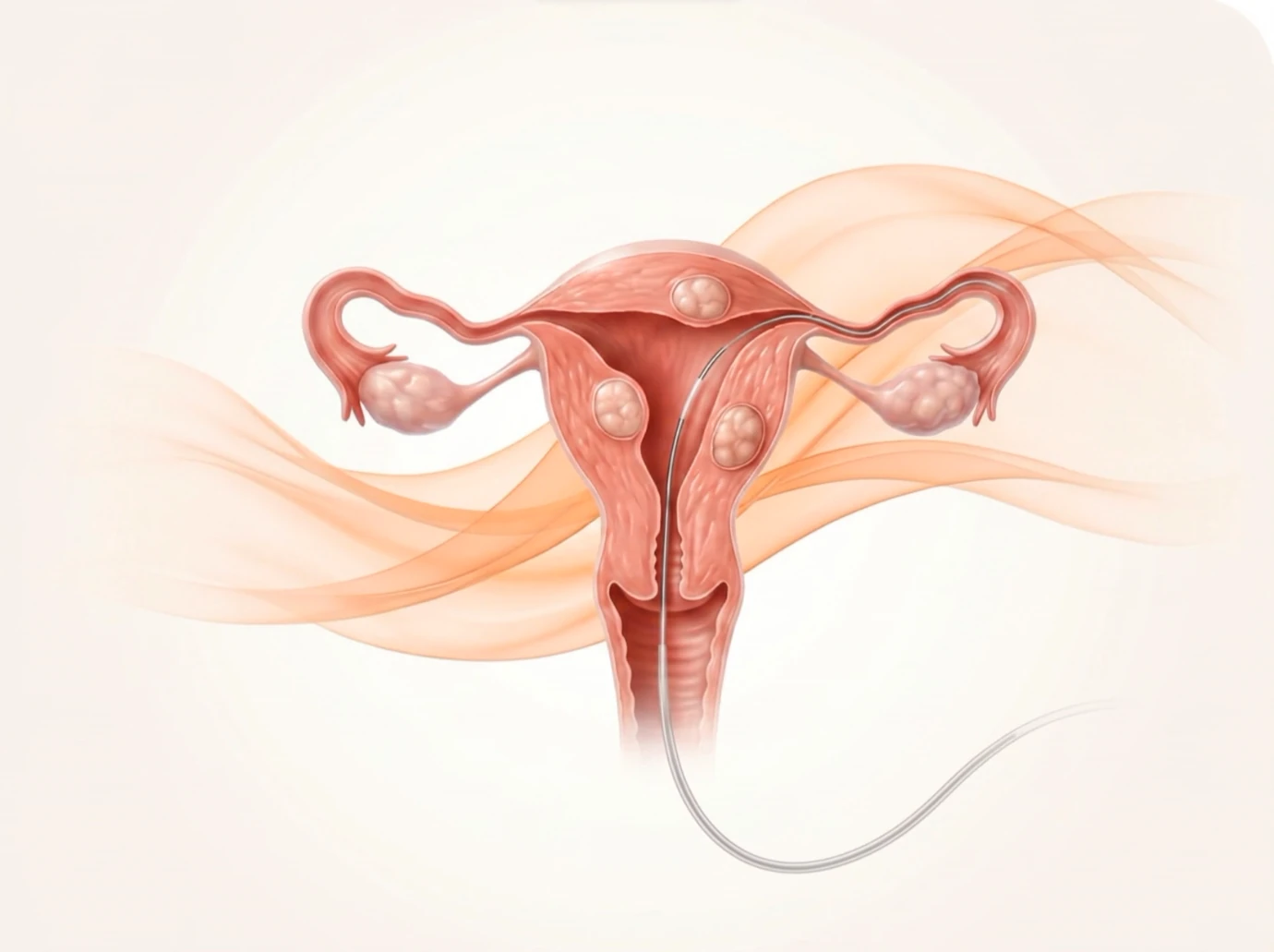
In microwave ablation, Dr. Nagateja Bonala guides a thin probe through the skin of the lower tummy into the fibroid, watching it live on ultrasound. Microwave energy at the tip heats the fibroid and kills its tissue. Over the next months the body slowly absorbs the treated fibroid and it shrinks. The uterus stays, and no part of it is cut open.
Who it suits best
Microwave ablation is the gentlest first step for:
- Smaller fibroids, one to a few, that can be clearly seen on ultrasound.
- Unmarried women. It is done through the tummy skin (the transabdominal route), so nothing is passed through the vagina.
- Women planning a pregnancy in the near future. There is no cut or stitch line in the uterine wall, and the lining is left alone.
- Women who want to avoid surgery and get back to work or college within days.
- A fibroid that has grown back after an earlier operation.
What happens on the day
The whole visit is usually a day, sometimes with one night's stay.
- Scan and plan: your MRI or ultrasound is used to plan a safe path for the needle.
- Comfort: local anaesthetic numbs the skin and sedation keeps you relaxed.
- Needle in: a thin probe is guided into the fibroid under live ultrasound.
- Heat: the fibroid is heated for about 30 to 40 minutes in total, depending on its size.
- Home: a small dressing covers the needle spot. Most women go home the same day or next morning.
Results
A 2021 review pooled 10 studies with 671 women. Fibroid symptom scores fell by about two-thirds, quality of life scores rose, blood counts improved, and no major complications were reported. Minor side effects such as pain or a low fever happened in about 1 in 5 women and settled on their own [1].
A 2025 review of 14 studies and 754 women found the same pattern: less bleeding and pressure, better quality of life and higher haemoglobin [2].
In a 2026 study comparing microwave ablation with keyhole surgery (laparoscopic myomectomy), symptom relief at 6 months was similar. The fibroids treated with microwave ablation shrank by about 60% in 6 months, and those women had a shorter hospital stay and lower costs [3].
Microwave ablation, UFE or surgery
All three treat fibroid symptoms. They suit different fibroids.
| Microwave ablation | UFE | Myomectomy | |
|---|---|---|---|
| Cut | None, one needle in the tummy | None, tiny tube in wrist or groin | Tummy or keyhole cuts |
| Uterine wall | Not cut | Not cut | Cut and stitched |
| Best for | Smaller, few fibroids | Many fibroids or bulky uterus | Selected fibroids |
| Hospital stay | Same day or 1 night | Same day or 1 night | 2 to 4 days |
| Back to routine | 3 to 5 days | 7 to 10 days | 2 to 6 weeks |
Recovery
Most women are surprised by how quickly they are back on their feet.
- Days 1 to 3: mild cramps or a dull ache, eased with tablets.
- Days 3 to 5: back to desk work, college and daily routine.
- Months 1 to 3: bleeding and pressure settle.
- Months 3 to 6: a follow-up scan shows how much the fibroid has shrunk.
Adenomyosis
When adenomyosis forms one thick patch in the uterine wall (an adenomyoma), microwave ablation can treat it the same way. In a study of 142 women treated for adenomyosis, ovarian hormone levels stayed normal after ablation [4]. When adenomyosis runs through the whole wall, uterine artery embolization, with a Mirena added if needed, usually works better. Our adenomyosis guide explains that plan.
Your consultation
Bring your ultrasound or MRI report, recent blood tests and any earlier treatment notes. Dr. Nagateja Bonala checks the size, number and position of each fibroid and tells you whether microwave ablation, UFE or another route fits you best.
Frequently asked questions
- Is microwave ablation for fibroids done through the vagina?
- No. At Clinic Seven it is done through the skin of the lower tummy (the transabdominal route). Nothing is passed through the vagina, so it suits unmarried women.
- Can I get pregnant after microwave ablation?
- Yes, that is one of the main reasons women choose it. The uterus is kept, its wall is not cut, and pregnancies after microwave ablation have been reported. Dr. Nagateja Bonala plans the timing with you, usually allowing a few months for the fibroid to shrink first.
- What size of fibroid can be treated?
- It works best for smaller fibroids, one to a few, that can be clearly seen and reached on ultrasound. Larger fibroids can sometimes be treated in more than one session. If there are many fibroids, embolization (UFE) usually treats them all better in one sitting.
- Does it hurt?
- Local anaesthetic and sedation keep you comfortable during the procedure. Afterwards most women have cramps for 2 to 3 days that settle with tablets.
- Will the fibroid come back?
- A treated fibroid usually keeps shrinking. New fibroids can grow over the years in some women, and they can be treated again the same way.
References
- Liu L, Wang T, Lei B. Ultrasound-guided microwave ablation in the management of symptomatic uterine myomas: a systematic review and meta-analysis. J Minim Invasive Gynecol. 2021;28(12):1982-1992. Read the source
- Ahmad F, Khan AI, Asif A, et al. Clinical efficacy of percutaneous microwave ablation in treating uterine fibroids: a comprehensive systematic review and meta-analysis. Eur J Obstet Gynecol Reprod Biol. 2025;310:113954. Read the source
- Xia M, Zhao S, Zhang Z, et al. Ultrasound-guided transabdominal microwave ablation versus laparoscopic myomectomy for FIGO type 3-5 uterine fibroids: a retrospective comparison of efficacy and safety. Front Med (Lausanne). 2026;13:1905429. Read the source
- Yang Y, Zhang J, Han ZY, et al. Ultrasound-guided percutaneous microwave ablation for adenomyosis: efficacy of treatment and effect on ovarian function. Sci Rep. 2015;5:10034. Read the source
Want to discuss your options?
Speak with the Clinic Seven team.