Patient guide
Gastric varices: BRTO, PARTO and CARTO explained
How BRTO, PARTO (plug-assisted) and CARTO (coil-assisted) retrograde transvenous obliteration treat bleeding gastric varices without surgery, how they differ, and the risks to know about.
Gastric varices at a glance
- No abdominal operationThrough a neck or groin vein
- Closes the feeding shuntVarices lose their flow
- 3 versionsBRTO, PARTO, CARTO
- Checked firstOesophageal varices and ascites
- Short stayA few days



Why gastric varices are different
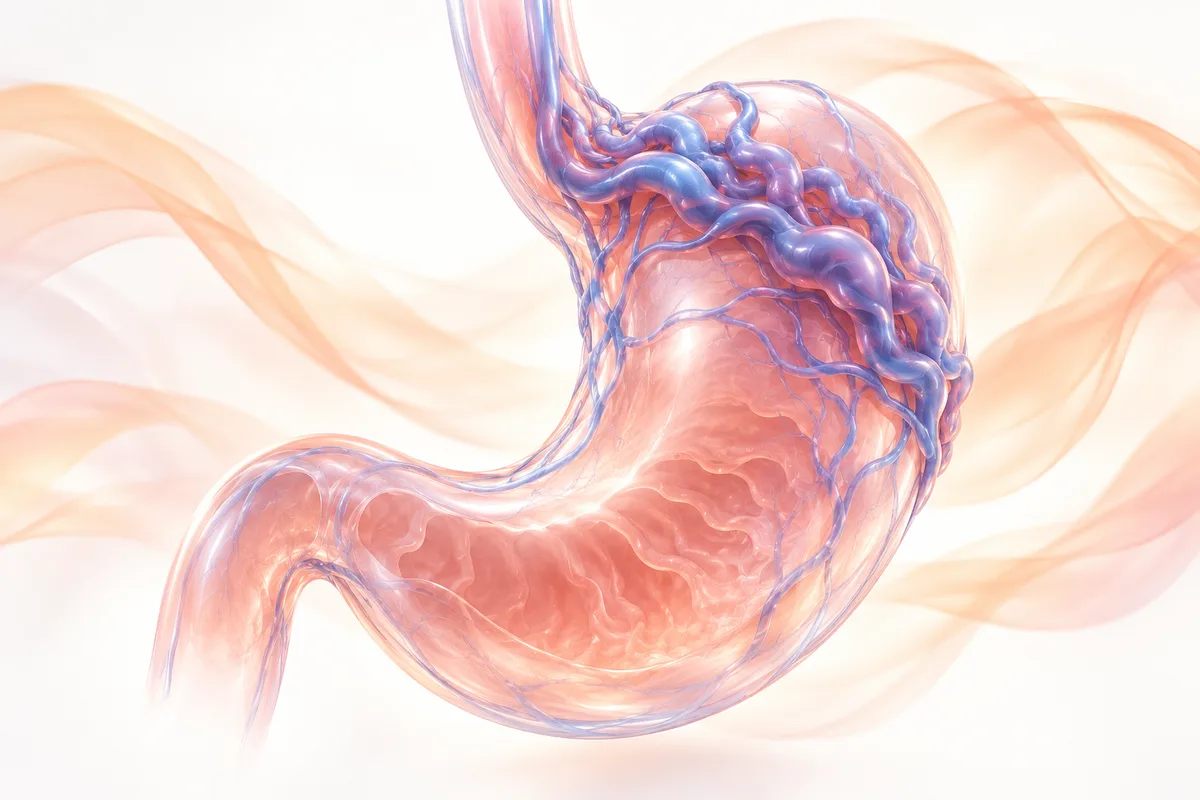
Gastric varices bleed less often than oesophageal ones but more severely, and they are harder to control with endoscopic banding. In many patients they connect to a large natural shunt that drains into the left renal vein. This shunt can be used to treat them from the vein side.
BRTO, PARTO and CARTO: the three versions
All three go through a vein in the neck or groin to the shunt and close it. They differ in how.
| BRTO | PARTO | CARTO | |
|---|---|---|---|
| Stands for | Balloon-occluded retrograde transvenous obliteration | Plug-assisted retrograde transvenous obliteration | Coil-assisted retrograde transvenous obliteration |
| How the shunt is closed | A balloon blocks the shunt while a sclerosant is injected | A vascular plug closes the shunt, with less or no sclerosant | Coils close the shunt, with less or no sclerosant |
| Balloon left in place | Yes, for hours | No | No |
| Main idea | The original technique | A shorter procedure without a balloon catheter left in place | A coil-based version that avoids the balloon wait [1] |
What the evidence shows
The evidence for these techniques comes mainly from case series and cohort studies. In the CARTO study of 20 patients with portal hypertensive variceal bleeding, closure was achieved in every patient and there was no rebleeding during follow-up averaging 384 days. Five patients (25%) had minor complications, including worsening of oesophageal varices and ascites, and one patient died from thrombosis and multi-organ failure [1].
Risks and trade-offs
Closing the shunt redirects blood flow to the rest of the portal system. In some patients this worsens oesophageal varices or ascites, which are then treated with banding, drugs or a TIPS. Because of this, patients are checked carefully beforehand, and in some the best option is a TIPS, endoscopic glue, or a combination. Your team chooses the approach for you [1].
Getting an opinion
Bring your endoscopy report, a triphasic CT or CT angiogram, and liver function tests. Dr. Nagateja Bonala reviews them and explains whether BRTO, PARTO, CARTO, TIPS or endoscopic treatment fits.
Frequently asked questions
- What is BRTO?
- Balloon-occluded retrograde transvenous obliteration closes the shunt that feeds gastric varices from inside the veins, using a balloon and a sclerosant, so the varices shrink without an abdominal operation.
- What is the difference between BRTO, PARTO and CARTO?
- BRTO uses a balloon and sclerosant, PARTO uses a vascular plug, and CARTO uses coils. The aim is the same: to close the shunt feeding the varices [1].
- Can gastric varices be treated without surgery?
- Yes. BRTO and its variants, TIPS, and endoscopic glue injection are non-surgical options, chosen according to your anatomy and liver function.
- What are the side effects of BRTO?
- Worsening oesophageal varices or ascites can follow, because blood flow is redirected. Your team monitors for this and treats it if needed [1].
References
- Lee EW, et al. Coil-assisted retrograde transvenous obliteration (CARTO) for the treatment of portal hypertensive variceal bleeding: preliminary results. Clin Transl Gastroenterol. 2014. Read the source
- de Franchis R, Bosch J, Garcia-Tsao G, Reiberger T, Ripoll C; Baveno VII Faculty. Baveno VII - Renewing consensus in portal hypertension. J Hepatol. 2022;76(4):959-974. Read the source
Want to discuss your options?
Speak with the Clinic Seven team.