Patient guide
UFE vs hysterectomy for fibroids: what the trials show
How uterine fibroid embolization (UFE) compares with hysterectomy for symptomatic fibroids: quality of life, recovery, satisfaction at 5 and 10 years, the chance of needing further treatment, and where myomectomy fits, with references.
Advantages over surgery at a glance
- Keep your uterusNothing is removed
- No cuts, no scarsJust a thin tube
- Home in one dayNo long hospital stay
- Faster recoveryBack to daily life sooner
- Low complication ratesA gentler path than surgery
- High satisfactionMost women stay happy for years




Who this comparison is for
Fibroids are the most common solid tumour in women and the leading reason hysterectomy is performed, but many women want options that keep the uterus [1]. If heavy periods, pelvic pressure or pain from fibroids are affecting your life, the realistic choices are usually hysterectomy, myomectomy (removing the fibroids and keeping the uterus) and uterine fibroid embolization (UFE).
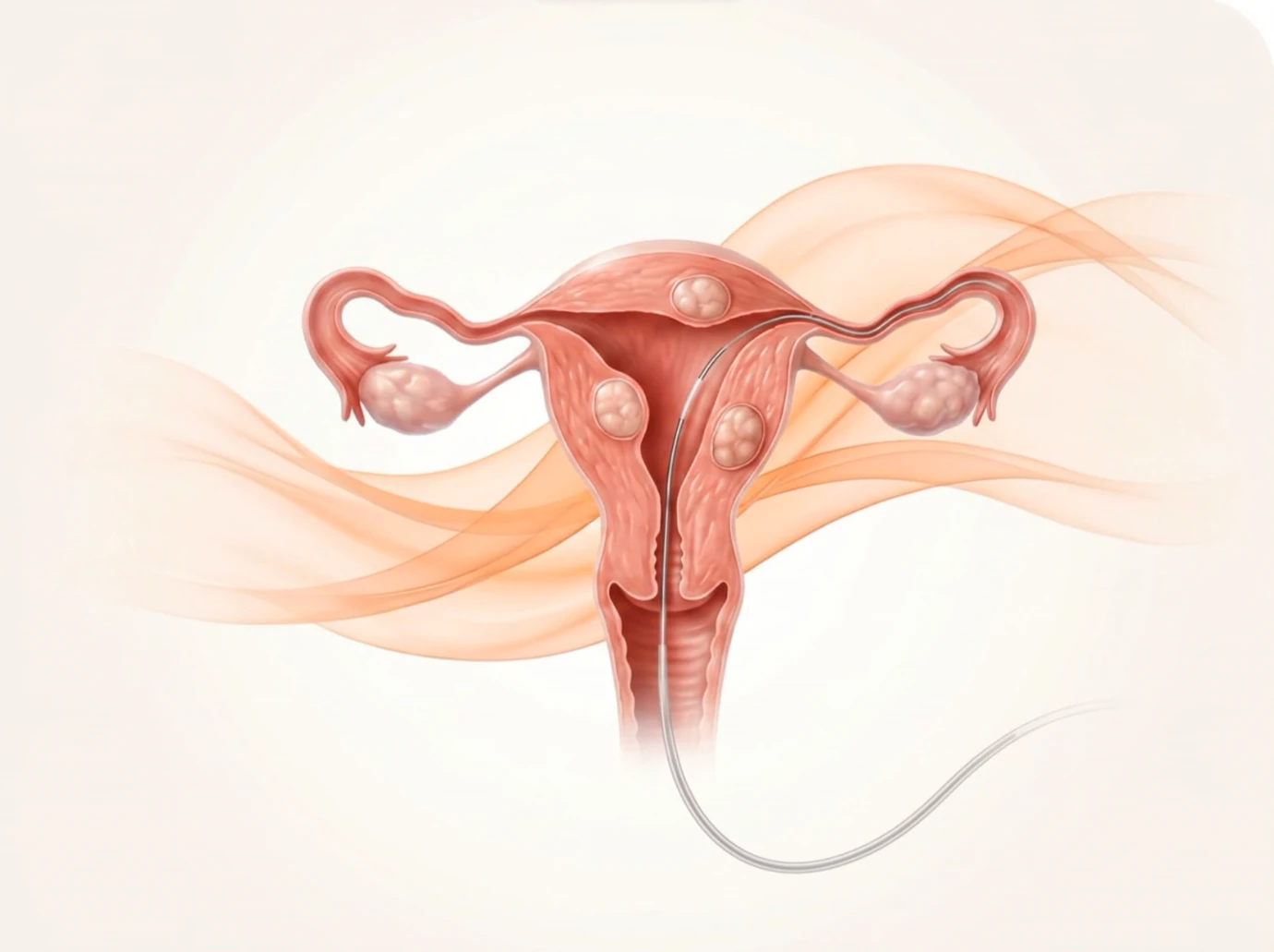
UFE works by passing a thin catheter through an artery into the uterine arteries and blocking the blood supply to the fibroids with tiny particles, so the fibroids shrink over the following months. Nothing is cut out and the uterus stays in place.
The trials below mostly enrolled women who were already considering surgery for symptomatic fibroids. Your own scan, symptoms and plans for pregnancy decide which option fits you.
Why women choose UFE
Women who look into UFE are usually looking for relief from fibroid symptoms without losing their uterus or going through major surgery. Here is what draws them to it.
- To keep their uterus. UFE treats the fibroids from inside the blood vessels, so nothing is removed [2, 5].
- No abdominal incision. The procedure is done through a small catheter.
- A shorter stay and a faster return to normal life: an average of 1 day in hospital against 5 after surgery, and a significantly earlier return to work [2].
- A quick recovery. At Clinic Seven, most patients are back to normal activity within about a week.
- Better physical wellbeing in the first weeks: significantly better physical scores at six weeks in the EMMY trial [4].
- Lasting results: about two thirds of women still had their uterus 10 years later, and 78% were satisfied with their treatment [5].
Advantages over surgery: what you can avoid
Compared with hysterectomy, UFE lets you avoid a number of things that come with a major operation. These are the main ones.
- Losing your uterus. UFE treats the fibroids and leaves the uterus in place, and about two thirds of women still had theirs 10 years later [2, 5].
- An abdominal incision and surgical scar. UFE is done through a small catheter.
- A long hospital stay: an average of 1 day after UFE against 5 days after surgery [2].
- A slower return to normal life: women returned to work significantly sooner after UFE, and had significantly better physical scores at six weeks [2, 4].
- Major adverse events in the first year: 12% after UFE against 20% after surgery in the REST trial [2].
UFE and hysterectomy side by side
Two randomised trials looked at embolization directly against surgery: the REST trial in the United Kingdom and the EMMY trial in the Netherlands. In REST, most of the surgery group had a hysterectomy (43 of 51), the rest a myomectomy [2].
| Hysterectomy (surgery) | UFE | |
|---|---|---|
| The uterus | Removed | Kept in place |
| Incision | Abdominal or keyhole surgery | None, treated through a small catheter |
| Hospital stay | Average stay of 5 days, according to the REST study [2] | Average stay of 1 day, according to the REST study [2] |
| Return to work | Slower | Significantly sooner [2]. At Clinic Seven, most patients are back to normal activity within about a week |
| Quality of life | Improved | Improved significantly, and remained stable at 10 years [4, 5] |
| Physical wellbeing at 6 weeks | Lower in EMMY | Significantly better in EMMY [4] |
Quality of life and recovery
In the REST trial, 157 women were randomised to UFE or surgery. At one year, women who had embolization left hospital after an average of 1 day (versus 5 after surgery) and returned to work significantly sooner [2]. At five years, symptom relief and patient satisfaction were very high [3].
The EMMY trial randomised 177 women who were due to have a hysterectomy. Quality of life improved significantly after UFE from six months onwards, bowel symptoms improved, and women in the UFE group had significantly better physical scores at six weeks [4]. The authors concluded that UFE is a good alternative to hysterectomy [4].
A Cochrane review pooling seven randomised trials (793 women) found that UFE is a safe, minimally invasive alternative to surgery, with patient satisfaction rates comparable to surgery up to two years [6].
What happens ten years later
The EMMY trial followed its patients for 10 years. Ten years after UFE, about two thirds of women (65%) had avoided hysterectomy altogether. Quality of life remained stable, and 78% of women were satisfied with their treatment [5]. The authors concluded that UFE is a well-documented, less invasive alternative to hysterectomy that eligible women should be counselled about [5].
de Bruijn et al., Am J Obstet Gynecol 2016 [5].
Keeping your options open
UFE treats the fibroids and keeps your uterus, with planned follow-up afterwards. Choosing UFE does not close any doors: if more treatment is ever needed, surgery remains fully available, and your team will plan that with you. Women were very satisfied with their treatment in the long-term trials [3, 5], and adverse events were no more frequent after UFE than after surgery in REST [3].
Edwards et al., N Engl J Med 2007 [2]. Surgery group: 43 hysterectomies and 8 myomectomies.
If you may want a pregnancy: myomectomy
UFE trials mostly enrolled women who were not planning pregnancy [6], so family plans are an important part of your consultation. In the FEMME trial of 254 women, who wished to avoid hysterectomy, pregnancies and live births occurred after both UFE and myomectomy, with 7 live births after UFE and 5 after myomectomy over four years, and complications were reported in 24% after UFE and 29% after myomectomy [7]. Your gynaecologist and interventional radiologist can plan together what is best for you if a pregnancy is a goal.
Who tends to suit which option
These are patterns from the trials and guidance, not rules. The right choice follows your scan, symptoms and plans.
- UFE is often discussed for women with symptomatic fibroids who want to keep their uterus, avoid an abdominal incision and return to normal life sooner [2, 3, 5].
- Hysterectomy is the surgical option for women who want the uterus removed [1].
- Myomectomy is the surgical option for women who want to keep the uterus and plan a pregnancy [6, 7].
Questions to ask at your consultation
Bring your pelvic ultrasound or MRI and any blood tests, and ask:
- Do my fibroids, and my scan, fit embolization, or is another condition such as adenomyosis part of the picture?
- How much improvement in bleeding and pressure is realistic for fibroids like mine, and how soon?
- What results can I expect for my symptoms, given my scan?
- If I may want a pregnancy, how does embolization compare with myomectomy for me?
- What does recovery look like, and when can I expect to be back at work?
Frequently asked questions
- Is UFE a proven alternative to hysterectomy?
- Yes. Randomised trials show quality of life improves significantly after UFE, with a much shorter hospital stay and a faster return to work [2, 4], and the benefit lasts: quality of life remained stable at 10 years [5]. UFE keeps the uterus, and it is well documented as a less invasive alternative to hysterectomy [5, 6].
- Will I need a hysterectomy later after UFE?
- Most women do not. In the EMMY trial about two thirds had avoided hysterectomy 10 years after UFE [5]. Follow-up is planned, and surgery stays available if it is ever needed.
- How long is recovery after UFE?
- In the REST trial the average hospital stay was 1 day after embolization against 5 days after surgery, and women returned to work significantly sooner [2]. At Clinic Seven, most patients are back to normal activity within about a week. Your own recovery depends on your health and fibroid pattern, and your team will give you a plan.
- Can I get pregnant after UFE?
- Some women have, but UFE is mainly studied in women who do not plan a pregnancy [6]. In the FEMME trial there were 7 live births after UFE and 5 after myomectomy over four years, a difference that was not statistically significant [7]. If pregnancy matters to you, please discuss it before choosing.
- Where can I get fibroid embolization in Hyderabad?
- Dr. Nagateja Bonala offers uterine fibroid embolization at Clinic Seven, Kukatpally. Please bring your pelvic ultrasound or MRI to the consultation.
References
- American College of Obstetricians and Gynecologists. Management of Symptomatic Uterine Leiomyomas: ACOG Practice Bulletin, Number 228. Obstet Gynecol. 2021;137(6):e100-e115. Read the source
- Edwards RD, et al. Uterine-artery embolization versus surgery for symptomatic uterine fibroids. N Engl J Med. 2007;356(4):360-70. Read the source
- Moss JG, et al. Randomised comparison of uterine artery embolisation (UAE) with surgical treatment in patients with symptomatic uterine fibroids (REST trial): 5-year results. BJOG. 2011;118(8):936-44. Read the source
- Hehenkamp WJ, et al. Symptomatic uterine fibroids: treatment with uterine artery embolization or hysterectomy--results from the randomized clinical Embolisation versus Hysterectomy (EMMY) Trial. Radiology. 2008;246(3):823-32. Read the source
- de Bruijn AM, et al. Uterine artery embolization vs hysterectomy in the treatment of symptomatic uterine fibroids: 10-year outcomes from the randomized EMMY trial. Am J Obstet Gynecol. 2016;215(6):745.e1-745.e12. Read the source
- Gupta JK, et al. Uterine artery embolization for symptomatic uterine fibroids. Cochrane Database Syst Rev. 2014;2014(12):CD005073. Read the source
- Daniels J, et al. Uterine artery embolisation versus myomectomy for premenopausal women with uterine fibroids wishing to avoid hysterectomy: the FEMME RCT. Health Technol Assess. 2022;26(22):1-74. Read the source
Want to discuss your options?
Speak with the Clinic Seven team.