Patient guide
Painful periods? Bulky uterus, endometriosis and adenomyosis explained
Why periods hurt, what a bulky uterus, endometriosis and adenomyosis mean, which tests find the cause, and how Mirena, hormone injections, embolization and cryoablation fit in. A simple guide from an interventional radiologist in Hyderabad.
What interventional radiology adds
- Your uterus stays in placeEmbolization treats fibroids and adenomyosis without removing anything
- No hormones neededEmbolization works on the cause, not by switching your hormones off
- Usually day-careMost women go home the same day after embolization at Clinic Seven
- No big cut for scar endometriosisCryoablation freezes the painful lump through the skin

Is my period pain normal?
Some cramping during a period is common, and many women get it. It usually starts as the period begins and settles in a day or two. It is worth getting checked when the pain:
- keeps you from work, college or sleep
- is getting worse over the years
- comes with heavy bleeding, clots, or periods that last longer than a week
- continues between periods or hurts during sex
- no longer settles with ordinary painkillers
The main causes, in plain words
Most painful periods come from one of these.
| Cause | What it is | Clues |
|---|---|---|
| Ordinary period cramps | The uterus squeezes to shed its lining. Some women's bodies make more of the chemicals that trigger this. | Pain starts with the period, from the teenage years, and the scans are normal. |
| Fibroids | Non-cancerous lumps in the wall of the uterus. | Heavy periods, pressure in the lower belly, needing to pass urine often. See fibroid types and symptoms. |
| Adenomyosis | The lining of the uterus grows into its muscle wall, so the uterus swells and becomes tender. | Heavy, painful periods, often in women in their 30s and 40s, with an evenly enlarged uterus. |
| Endometriosis | Tissue like the uterus lining grows outside the uterus, for example on the ovaries or in the pelvis. | Pain before and during periods, pain during sex, sometimes trouble getting pregnant. |
| Swollen pelvic veins (pelvic congestion) | Enlarged, leaky veins around the ovaries and uterus, a little like varicose veins in the legs. | A dull, heavy ache that is worse after standing, around periods and after sex. It can be treated with ovarian vein embolization. |
| Other causes | A pelvic infection, a coil that does not suit you, an ovarian cyst, or a narrow cervix. | Fever, discharge or pain that does not follow the period. |
What does "bulky uterus" mean?
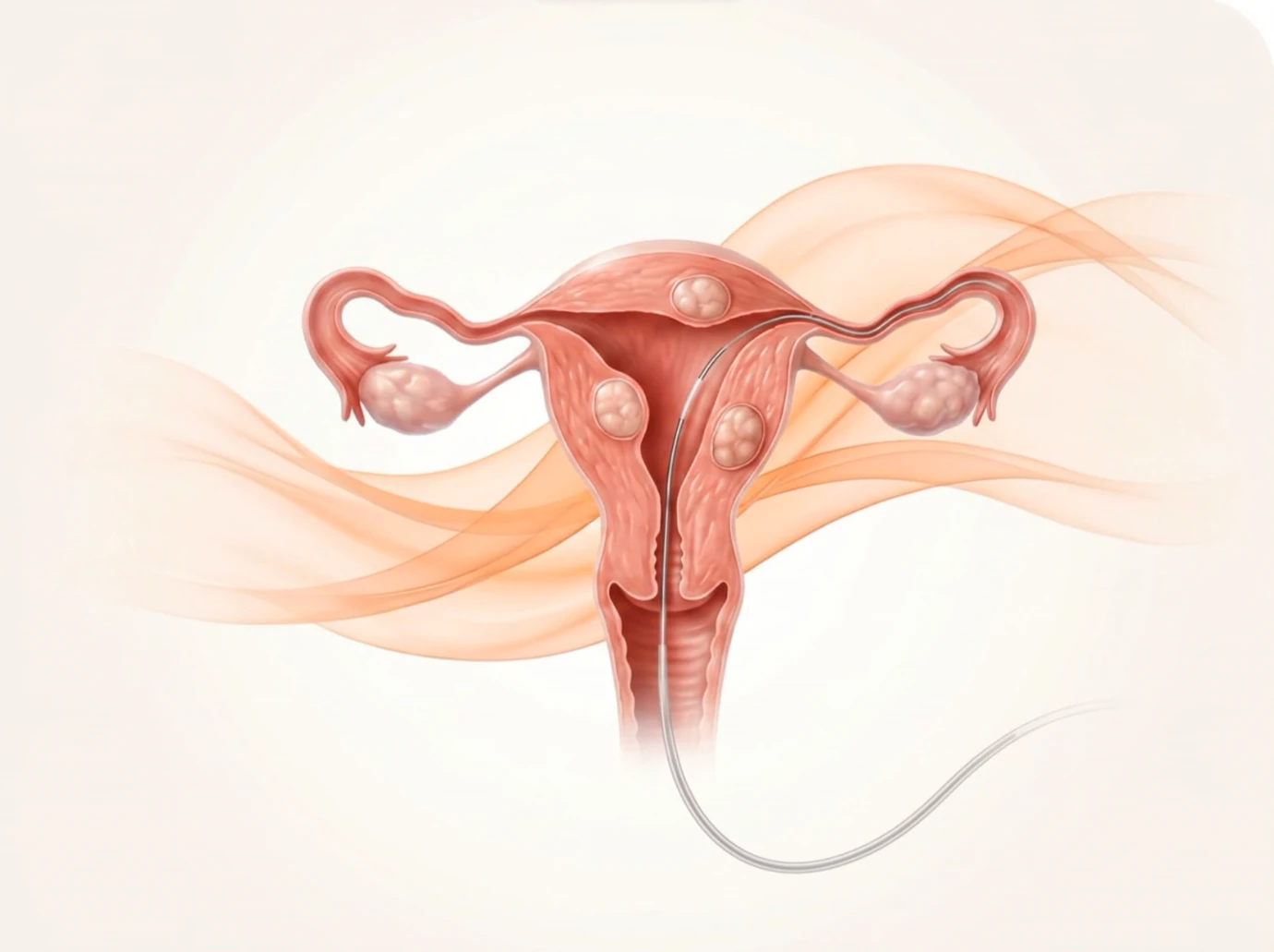
Your ultrasound report may say bulky uterus. That is a description of size, not a diagnosis. It means the uterus looks larger than expected. The next question is why: fibroids and adenomyosis are the two most common answers. Many women with a bulky uterus have no problems and only need to be watched. Treatment is for heavy bleeding, pain or pressure. Our guide on bulky uterus goes through it in more detail.
Adenomyosis and endometriosis: not the same thing
These two get confused all the time. Both involve tissue that behaves like the lining of the uterus, but they are in different places.
In adenomyosis, the tissue is inside the muscle wall of the uterus. The whole uterus can become larger and tender, and periods are heavy and painful.
In endometriosis, the tissue is outside the uterus, on the ovaries, in the pelvis or sometimes in a scar. Pain is the main problem, and it can affect fertility.
You can have both, and you can have fibroids as well. That is one reason an accurate scan matters before choosing a treatment. For adenomyosis specifically, read adenomyosis treatment without hysterectomy.
Which tests do you need?
Doctors usually go step by step, and not every woman needs every test.
- Your story and an examination. When the pain happens, how heavy the bleeding is, what you have tried, and whether you plan a pregnancy tells the doctor more than any single test.
- Blood tests. A blood count to check for anaemia from heavy bleeding, thyroid tests, and a pregnancy test when relevant. A blood test called CA-125 is sometimes done, but it cannot diagnose endometriosis or adenomyosis by itself.
- Ultrasound. This is usually the first scan. A pelvic or transvaginal ultrasound shows fibroids, ovarian cysts and often the signs of adenomyosis.
- MRI of the pelvis. This is the most detailed scan. It is the best way to tell fibroids from adenomyosis, to see how many there are and where, and to find deeper endometriosis. It is also what we use to plan a procedure.
- Laparoscopy (a keyhole look inside the belly). It is used for endometriosis when the picture is unclear or when treatment is needed at the same time. It is no longer always required just to make the diagnosis.
- A biopsy of the lining. This is done if bleeding is irregular or you are older, to check the lining itself.
How is the diagnosis made?
Doctors combine three things: your symptoms, the examination, and the scans.
Adenomyosis is suspected when a woman has heavy, painful periods and the scan shows an enlarged, rounded uterus with a thickened wall. MRI makes it clearer.
Endometriosis is suspected from the pain pattern and from findings such as an ovarian cyst filled with old blood. Small patches of endometriosis can be missed by ultrasound, so a normal scan does not rule it out. A painful lump in a caesarean scar that swells around periods is a classic sign of scar endometriosis.
Fibroids are usually easy to see on ultrasound, and MRI shows their exact number and position.
Treatment depends on the cause and on your plans
There is no single treatment for painful periods, because the causes are different. Three questions decide the plan: what exactly is causing it, how much it affects your life, and whether you want to have children. Tell the doctor your plans early, because they change the advice.
Important safety warning
Never take these medicines without a doctor
Every medicine on this page, including painkillers, needs a doctor who knows your history to prescribe it, set the dose and review you. Do not buy them over the counter. Do not take tablets a friend or relative used. Do not repeat an old prescription month after month. Some of these medicines are easy to get from a pharmacy without a prescription in India. That does not make them safe for you.
Hormone tablets in particular can cause blood clots in the legs and lungs, stroke and heart attack in women at risk. These are rare, but they are serious and sometimes fatal. Painkillers taken too often can cause stomach bleeding and kidney damage.
Before you start any of them, tell your doctor if any of these apply to you:
- You, or a parent, brother or sister, have had a blood clot in the leg or lung, a stroke or a heart attack
- You have a known clotting disorder
- You smoke, especially if you are over 35
- You are overweight
- You get migraines with aura (flashing lights or blind spots before the headache)
- You have high blood pressure, diabetes, high cholesterol or heart disease
- You have liver disease, or have had breast cancer or another hormone-sensitive cancer
- You have bleeding that has not been explained, or you might be pregnant or are breastfeeding
- You have had recent surgery, or face long bed rest or a long journey
- You have had a stomach ulcer, kidney disease or asthma (for painkillers)
- You take other medicines, especially blood thinners
First steps: painkillers, heat and bleeding control
For many women the first step is an anti-inflammatory painkiller such as ibuprofen or mefenamic acid, taken with food at the start of the period. A hot-water bag helps too. For heavy bleeding, tranexamic acid tablets are a non-hormonal option. These do not treat the cause, but they can make life easier while you find it. Take them only as your doctor advises, and read the side effects below.
Hormone pills and progestins
Birth control pills and progestin tablets such as dienogest are often the next step. They thin the lining and calm the pain, and are widely used for endometriosis and for heavy bleeding. They are medicines, and they have side effects. Some of them raise the risk of blood clots, so tell your doctor about any clot in you or your family. Our guide on hormone pills and blood clot risk explains who should be careful.
Mirena (hormone coil)
Mirena is a small coil placed inside the uterus. It releases a small amount of hormone locally. It is one of the best options for heavy bleeding, and it often eases the pain of adenomyosis. It is placed in a short visit and lasts for years.
It does not shrink fibroids or treat the cause. Spotting is common in the first few months. In a very large uterus the coil can sometimes slip out, so it needs to be checked after insertion. It is often used after embolization for adenomyosis if symptoms start to return.
GnRH injections and the newer GnRH tablets
These medicines switch off the signal that tells the ovaries to make hormones. Your body goes into a temporary menopause-like state. Periods stop, fibroids and an enlarged uterus can shrink, and pain from endometriosis and adenomyosis usually settles.
The injections (leuprolide and similar) are given every month or every three months. The newer tablets (called GnRH antagonists, such as relugolix, elagolix and linzagolix) do the same job by a different route. Availability differs from country to country, so ask what can actually be prescribed in India.
Because they act like menopause, they usually cause hot flushes, mood changes and, over time, thinning of the bones. For this reason they are used for a few months, often before surgery or a procedure, sometimes with small amounts of hormones added back. Periods and symptoms often return after stopping. They are a bridge, and not usually a permanent answer. Some combination tablets contain estrogen again, so the clot question in our hormone pills guide applies to them too.
Side effects and risks of each medicine
Every medicine has side effects. Most are mild and settle, but some are serious. This table is not a complete list. Read the leaflet, and ask your doctor or pharmacist about anything you notice. Stop and get medical help straight away if you have any of the warning signs listed further down.
| Medicine | Common side effects | Serious risks, and who must be extra careful |
|---|---|---|
| Painkillers (ibuprofen, mefenamic acid) | Acidity, stomach upset, nausea | Stomach ulcers and bleeding, kidney damage, asthma attacks in sensitive people. Taken with hormone pills, they can add to clot risk. Extra care: stomach ulcer, kidney disease, asthma, heart disease, pregnancy, blood thinners. |
| Tranexamic acid | Nausea, diarrhoea, headache | Blood clots in women already at risk. Extra care: a past clot or clotting disorder, kidney disease, taking hormone pills. |
| Combined birth control pills | Nausea, breast tenderness, headache, spotting, mood changes | Blood clots in the legs or lungs, stroke, heart attack, raised blood pressure. Extra care: a past clot, smokers over 35, migraine with aura, high blood pressure, liver disease, breast cancer. |
| Progestin tablets (norethisterone, dienogest, medroxyprogesterone) | Spotting or irregular bleeding, bloating, breast tenderness, mood changes or low mood, acne, weight gain, headache | Blood clots, especially with higher doses. Extra care: a past clot, liver disease, breast cancer, depression, unexplained bleeding. |
| Mirena (hormone coil) | Spotting and irregular bleeding in the first months, cramps after insertion, acne, breast tenderness, small harmless ovarian cysts | The coil slipping out, infection soon after insertion, rarely a hole in the wall of the uterus. Extra care: a pelvic infection, an unusually shaped uterus, possible pregnancy, breast cancer. |
| GnRH injections and tablets | Hot flushes, sweating, headache, mood changes, low sex drive, vaginal dryness, poor sleep | Bone thinning with longer use. Combination tablets that contain estrogen carry a clot risk. Extra care: thin bones (osteoporosis), depression, a past clot (for combination tablets), pregnancy. |
Uterine artery embolization (UAE)
Embolization treats fibroids and adenomyosis by working on their blood supply. A thin tube is passed through a tiny puncture, usually at the wrist or groin, to the arteries feeding the uterus. Small particles are released to reduce the blood flow to the problem area. There is no cut, no hormone and no part of the uterus is removed.
Most women go home the same day. Cramping is common for the first day or two. Over the following months the fibroids or the thickened wall shrink and bleeding and pain settle for most women.
It is not for everyone. If you are planning a pregnancy, tell us at the start, because other options may suit you better. Some women need more treatment later. And embolization does not treat endometriosis itself, meaning ovarian cysts or deep pelvic disease. Those need a different approach.
Read more about uterine fibroid embolization, how it compares in UFE vs hysterectomy, and what it costs in our UFE cost guide.
Cryoablation: freezing the problem
Cryoablation uses a thin needle to freeze and destroy painful tissue, guided by ultrasound or MRI. It is done through the skin, with no large incision.
It is well established for scar endometriosis, the tender lump that can form in a caesarean or other abdominal scar. At Clinic Seven, we freeze the lump through the skin. Read more about cryoablation for scar endometriosis.
Freezing is also being tried for adenomyosis and for fibroids inside the uterus. This is newer, and it is still being studied. It is not yet available everywhere, and it is not a first choice for most women. We will tell you honestly if it makes sense for you.
Before you agree to remove your uterus
Why we try to avoid hysterectomy
Many women in their 30s and 40s are still told to remove the uterus for fibroids, adenomyosis or heavy bleeding, conditions that are not cancer and can often be treated without any operation. Hysterectomy is permanent, and it can change far more than your periods. Large long-term studies, especially in women under 50, link it with these risks. Read the evidence in hysterectomy side effects.
- Menopause can come early, even when your ovaries are left in
- Higher risk of heart disease, high blood pressure and stroke
- Weaker bones, joint pain and loss of muscle strength
- The body may age faster
- You may need another operation later for leaking urine
- Higher risk of depression and anxiety, especially if it is done young
- Sex can get worse: lower sex drive and less comfortable sex, especially if the ovaries are removed too
- No pregnancy, ever. It cannot be undone
Surgery
Embolization now treats many fibroids and adenomyosis without an operation, so surgery is usually needed for other reasons. Laparoscopy can remove endometriosis and treat ovarian cysts. Myomectomy cuts fibroids out and is sometimes chosen when pregnancy is the main goal. Hysterectomy is the last resort, for cancer or when everything else has failed. Read what removing the uterus can change in hysterectomy side effects, and compare the options in alternatives to hysterectomy and myomectomy vs UFE.
Which treatment suits which problem?
Medicines and procedures do two different jobs. Temporary treatment means medicines, including Mirena: they control bleeding and pain while you use them, always on a doctor's advice. They do not remove fibroids or cure adenomyosis, and symptoms usually return when you stop. Long-term treatment means a procedure that works on the cause itself. This is a general map, not a prescription. Your own plan depends on your scans, your age and your wishes, and every medicine needs a doctor's advice.
| Problem | Temporary treatment | Long-term treatment |
|---|---|---|
| Fibroids | Bleeding and pain can be eased while you take medicines. Fibroids stay, and GnRH medicines shrink them only for a few months. | Uterine fibroid embolization keeps the uterus. Myomectomy removes the fibroids. Hysterectomy is the last resort. |
| Adenomyosis | Mirena or hormone medicines can ease heavy, painful periods. The condition stays. | Uterine artery embolization keeps the uterus, with Mirena added later if needed. Hysterectomy is the last resort. |
| Endometriosis (pelvic or ovarian) | Hormone medicines control the pain while you take them, on a doctor's advice and with regular review. | Laparoscopy (keyhole surgery) to remove it or treat ovarian cysts. |
| Scar endometriosis (a lump in a surgical scar) | Hormones help some women but often do not settle the lump. | Cryoablation freezes the lump through the skin. Surgery can cut it out. |
| Swollen pelvic veins (pelvic congestion) | Painkillers may help for a while. | Ovarian vein embolization closes the faulty veins. |
| Heavy bleeding, cause not yet clear | Short-term relief on a doctor's advice, while you are investigated. | Tests first. The right treatment depends on what they find. |
Planning a pregnancy?
Fertility can be affected by endometriosis, adenomyosis and fibroids, and the right treatment depends on how soon you want to conceive. Some hormone treatments stop ovulation while you take them. Some procedures suit women who have completed their family better than those still planning one. Please tell us your plans at the first visit.
When to see a doctor urgently
Do not wait for an appointment if you have any of these:
- Soaking a pad or more every hour, or fainting from bleeding
- Sudden severe pelvic pain, or pain with a fever
- Bleeding after menopause
- Pain with swelling and warmth in one leg, or sudden breathlessness or chest pain (these can be signs of a blood clot, see DVT symptoms)
- Sudden weakness or numbness on one side, a drooping face, trouble speaking or a sudden severe headache (these can be signs of a stroke)
What to bring and what to expect at Clinic Seven
Bring your latest ultrasound or MRI, your blood reports and a list of the tablets and injections you have tried. We look at your scans first and then tell you which options suit you, including the ones that are not ours. If you cannot come in yet, you can send your reports for a second opinion. Dr. Nagateja Bonala is an interventional radiologist at Clinic Seven, Kukatpally, and works alongside your gynaecologist. He performs uterine artery embolization for fibroids and adenomyosis, and cryoablation for scar endometriosis.
Frequently asked questions
- Is severe period pain normal?
- Some cramping is common, but pain that stops you from working, gets worse over the years or comes with heavy bleeding is not something to accept. It often has a cause that can be found and treated.
- Can I have endometriosis if my ultrasound is normal?
- Yes. Small patches of endometriosis are often not visible on ultrasound. If your symptoms point to it, your doctor may suggest an MRI or a laparoscopy.
- Do I need an MRI for painful periods?
- Not always. Many women start with an ultrasound. An MRI is useful when the cause is unclear, when adenomyosis or deeper endometriosis is suspected, and before planning a procedure like embolization.
- What is the difference between adenomyosis and endometriosis?
- In adenomyosis the lining-like tissue grows into the muscle wall of the uterus. In endometriosis it grows outside the uterus. You can have both, and you can have fibroids as well.
- Does Mirena treat fibroids or adenomyosis?
- Mirena reduces heavy bleeding and often eases the pain of adenomyosis, but it does not shrink fibroids. In a very large uterus it can slip out, so it needs a check after insertion.
- Are GnRH injections a permanent solution?
- No. They put the body in a temporary menopause-like state, so they are usually used for a few months because of hot flushes and bone thinning. Symptoms often return after stopping, so they are used as a bridge, for example before a procedure.
- Can I buy period pain or hormone tablets from the pharmacy myself?
- Please do not. Even when a pharmacy will sell them without a prescription, these medicines need a doctor who knows your history. Hormone tablets can cause blood clots and stroke in women at risk, and painkillers taken too often can cause stomach bleeding and kidney damage.
- Can embolization treat endometriosis?
- No. Embolization treats fibroids and adenomyosis. Endometriosis on the ovaries or in the pelvis needs other treatments such as medicines or laparoscopy. A tender lump in a surgical scar can be treated with cryoablation.
- Is hysterectomy the only cure for adenomyosis?
- No. Hysterectomy is the definitive option, but many women are managed with Mirena, hormonal medicines or uterine artery embolization, and keep their uterus. We help you choose after the scans.
- Where can I get this treated in Hyderabad?
- Dr. Nagateja Bonala sees women with painful and heavy periods at Clinic Seven, Kukatpally. Bring your scan reports for the first visit.
Get a rough idea of the cost
Choose what matters to you and we will show a guide. Nobody is committed to anything, and our team will never rush you.
Want to discuss your options?
Speak with the Clinic Seven team.