Patient guide
Hysterectomy side effects: what removing your uterus can change
Long-term side effects of hysterectomy, even when the ovaries are kept: earlier menopause, heart and blood pressure problems, bladder leakage and low mood. What studies show, when hysterectomy is still right, and the options that keep your uterus.
What studies link to hysterectomy
- Early menopauseEven when the ovaries are left in. Hot flushes and bone loss can start sooner.
- Higher risk of heart diseaseIncluding stroke and high blood pressure, especially if done young.
- Weaker bonesHigher risk of osteoporosis, especially if the ovaries are removed too.
- Joint pain and arthritisIncluding rheumatoid arthritis and numb, painful hands (carpal tunnel).
- Muscle loss and weaknessHigher risk of sarcopenia, more so if the ovaries are removed.
- Your body may age fasterSigns of faster ageing were found after hysterectomy.
- Higher risk of urine leakageMay need further urological surgeries later.
- Sex can get worseA shorter vagina and lower sex drive, especially if the ovaries are removed too.
- Higher risk of depression and anxietyMore so when the uterus is removed at a younger age.
- Thyroid lumps and thyroid cancerHigher risk in women who had the operation in their 40s and 50s.
What embolization offers instead
- Home the same dayNo long hospital stay.
- Less bleeding, less painTreats fibroids and adenomyosis at the source.
- Back to normal life in under a weekNot several weeks of recovery.
- Uterus and ovaries stayNothing is removed.
- No cut, no stitchesJust a pinhole in the wrist or groin.
- No general anaesthesiaLocal anaesthesia with light sedation.



A hysterectomy cannot be undone
Many women in their 30s and 40s are told to remove the uterus for fibroids, adenomyosis or heavy bleeding, even for fibroids that could be treated without any operation. Before you agree, know what you are giving up.
Hysterectomy means removing the uterus. Sometimes the cervix, tubes or ovaries are removed too. It ends periods and any chance of pregnancy, permanently. It is still one of the most common operations offered to women for fibroids, adenomyosis and heavy bleeding, conditions that are not cancer.
For some women it is the right choice, and many are happy afterwards. But the uterus is not just a place where babies grow. The operation can change how the body ages, and those changes are rarely explained in the clinic. This page explains them in plain words, so you can decide knowing the full picture.
The operation itself
Hysterectomy is major surgery under general or spinal anaesthesia. Like any operation, it can cause bleeding, infection, injury to the bladder or bowel, and blood clots in the legs or lungs. Recovery usually takes several weeks, with no heavy lifting and time off work.
With uterine fibroid embolization, most women go home the next day or sooner, against about 5 days in hospital after surgery, and they get back to work faster [11].
Menopause can come earlier, even if your ovaries are kept
Many women are told that if the ovaries are left in, nothing changes. That is not quite true. The uterus and ovaries share some of their blood supply, and removing the uterus can make the ovaries slow down early.
Within 5 years of hysterectomy, about 1 in 5 women had already reached menopause. Without the operation, it was about 1 in 14 [1]. Early menopause means hot flushes, weaker bones and a higher heart risk, years sooner.
If the ovaries are removed too, menopause starts the day of the operation. In Indian hospitals, ovaries are often removed even when there is nothing wrong with them [8]. If you are told your ovaries will be removed, ask why.
Heart, blood pressure and weight
Women who have a hysterectomy, especially before 50, are more likely to develop heart disease, high blood pressure, high cholesterol and weight gain later in life. This has been seen again and again in large studies [2, 3, 4].
The younger you are at the operation, the bigger the risk. Women who had a hysterectomy at 35 or younger had more than double the risk of heart disease [2]. Stroke risk was also higher, even when the ovaries were left in [4].
In women with fibroids, removing only the fibroids and keeping the uterus was not linked to more heart disease. Removing the uterus was [5].
Bones, joints, muscles and ageing
Hysterectomy can affect your whole body, not just the pelvis.
Weaker bones. In the years after hysterectomy, women were more likely to develop osteoporosis, where bones become thin and weak. The risk was higher, and lasted longer, when the ovaries were removed too [16].
Joint pain and arthritis. Even with the ovaries kept, women who had a hysterectomy were more likely to develop arthritis, rheumatoid arthritis and carpal tunnel syndrome, which causes numb, tingling and painful hands [17].
Muscle loss and weakness. Hysterectomy was linked to a higher risk of sarcopenia, the loss of muscle and strength that makes everyday work harder as you age. The risk was about double when the ovaries were removed too [18].
Faster ageing. In tests that measure how old the body really is, women who had a hysterectomy showed signs of ageing faster than their years [19].
Bladder leakage and the pelvic floor
The uterus helps support the bladder and the floor of the pelvis. After a hysterectomy, women were more than twice as likely to need another operation later for leaking urine, the kind that happens when you cough, sneeze or lift something. This was true however the hysterectomy was done [6].
Sex can get worse after hysterectomy
Removing the uterus can make your sex life worse. Many women are not told this before the operation.
When the cervix is removed along with the uterus, the vagina becomes about a third shorter, and women reported that sex got worse. Nerves and sensitive tissue at the top of the vagina can be damaged [13].
If the ovaries are removed too, the level of testosterone, the hormone that drives sexual desire, falls [14]. And because menopause can come early, dryness, painful sex and low desire can start sooner.
Whatever you may hear, the operation does not make sex better [12].
Mood and mental health
Women who have a hysterectomy are more likely to develop depression and anxiety in the years afterwards, even when the ovaries are kept. The younger the woman at the operation, the higher the risk of depression [7].
Thyroid problems
Women who had a hysterectomy in their 40s and 50s were more likely to develop thyroid lumps (nodules), a swollen thyroid (goitre) and thyroid cancer in the years afterwards, whether or not the ovaries were removed [20].
Hysterectomy in India: often too young, often without enough explanation
In India, hysterectomy is often done on women who are still having periods, and about 1 in 4 are under 40. The most common reasons are fibroids and heavy bleeding, conditions that can usually be treated without removing the uterus. Doctors reviewing these operations have called for more women to be offered treatments that keep the uterus [8].
Women who had a hysterectomy before 35 often said nobody had explained the other options to them, and many regretted the decision [9].
What these studies can and cannot tell you
Not every woman who has a hysterectomy will have these problems. But the risks are real enough that you deserve to know them before you agree, especially if you are young [10].
Keep your uterus: embolization first
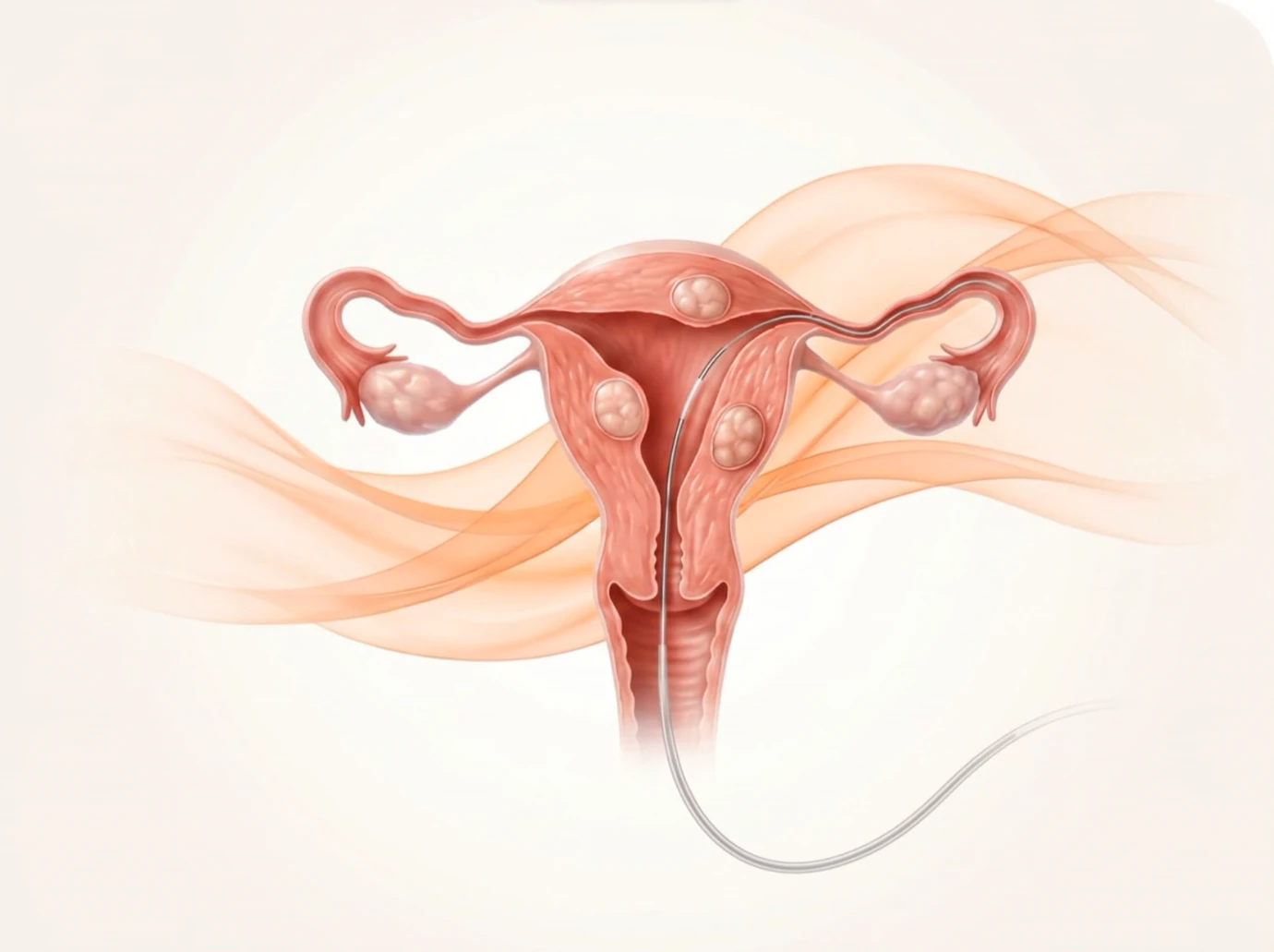
Interventional radiology treats the most common reasons women are offered a hysterectomy without removing anything. A thin tube is passed through a pinhole in the wrist or groin, and the problem is treated from inside the blood vessels, guided by live imaging:
- Fibroids: uterine fibroid embolization cuts off the blood supply to all the fibroids at once, so they shrink. No cut, no stitches, and the uterus stays.
- Adenomyosis and bulky uterus: uterine artery embolization treats the whole affected wall, with a Mirena added later if symptoms return. About 3 in 4 women get clearly better, with less bleeding, pain and swelling [15].
- Pelvic pain from swollen pelvic veins: ovarian vein embolization closes the faulty veins.
- Heavy bleeding while the cause is found: a Mirena coil or medicines, on a doctor's advice.
- Surgery that keeps the uterus also exists: myomectomy cuts the fibroids out. It is still an operation, with an incision and a longer recovery.
Why see an interventional radiologist before you decide
Most women offered a hysterectomy have only been seen by a surgeon. An interventional radiologist looks at the same scans and asks a different question: can this be treated without removing the uterus? With embolization:
- Your uterus, and with it your body's normal hormone balance, stays in place
- There is no abdominal cut, only a pinhole that needs no stitches
- It is done under local anaesthesia and sedation, not general anaesthesia
- Most women go home the same day at Clinic Seven, against about 5 days in hospital after surgery in the REST trial [11]
- Most women are back to normal life in about a week, instead of several weeks
- No hormone tablets are needed to keep the problem under control
When hysterectomy is still the right answer
Hysterectomy is the right operation for some women: for cancer or suspected cancer, for some types of prolapse, or when uterus-sparing treatments have already failed. We will tell you plainly if it is the best route for you. What matters is that it is your informed choice, not the only option you were shown. Our guide on alternatives to hysterectomy compares the options side by side.
Questions to ask before you agree to a hysterectomy
Take these to your appointment:
- What exactly is the diagnosis, and has it been confirmed on an MRI?
- Which treatments that keep the uterus are possible for me, and why are they not suitable?
- Do my ovaries need to be removed? If so, why?
- Will it be open surgery or keyhole surgery, and how long is recovery?
- How will this affect menopause, my bladder and my heart in the long run?
- Can I get a second opinion from an interventional radiologist before I decide?
Get a second opinion before you consent
If you have been advised a hysterectomy for fibroids, adenomyosis or heavy bleeding, a second opinion costs little and can save your uterus. Dr. Nagateja Bonala reviews scans and reports at Clinic Seven, Kukatpally, Hyderabad. You can also send your reports for a second opinion on WhatsApp before you visit.
Frequently asked questions
- What are the long-term side effects of hysterectomy?
- Early menopause, a higher risk of heart disease, stroke and high blood pressure, more chance of needing another operation for leaking urine, more depression and anxiety, and a worse sex life [1, 2, 3, 6, 7, 13]. Not every woman gets these, but the risk is real, especially if you are young.
- Does hysterectomy cause early menopause if the ovaries are kept?
- It can. About 1 in 5 women reach menopause within 5 years of the operation, against 1 in 14 without it [1]. If the ovaries are removed too, menopause starts straight away.
- Does hysterectomy cause body pain and weakness?
- It can. After hysterectomy, women are more likely to develop weak bones (osteoporosis), arthritis and joint pain, and loss of muscle strength, especially if the ovaries are removed too [16, 17, 18].
- Do women gain weight after hysterectomy?
- Women who have a hysterectomy are more likely to put on weight and develop high cholesterol and high blood pressure later [2]. Diet, activity and age matter too.
- What are the side effects of hysterectomy at 30 or 40?
- The risks are bigger the younger you are. Women who had a hysterectomy at 35 or younger had more than double the risk of heart disease [2], and a higher risk of depression [7].
- Is hysterectomy necessary for fibroids?
- Often not. Most fibroids can be treated with uterine fibroid embolization, which keeps the uterus, needs no cut and is usually a day-care procedure. The right choice depends on your scans and your plans, so see an interventional radiologist before you decide.
- Is hysterectomy necessary for adenomyosis?
- Not always. Many women with adenomyosis are treated with uterine artery embolization or a Mirena coil and keep their uterus. Hysterectomy remains an option if those do not work.
- Does sex get worse after hysterectomy?
- It can. Removing the cervix can make the vagina about a third shorter, and sex can get worse [13]. If the ovaries are removed too, testosterone, the hormone behind sex drive, falls [14], and early menopause can bring dryness and painful sex sooner.
- I am 38 with a small fibroid and have been told to remove my uterus. What should I do?
- Get a second opinion before you agree. Small and medium fibroids in women in their 30s and 40s can often be treated with uterine fibroid embolization, which keeps the uterus, needs no cut and is usually day-care. Bring your ultrasound or MRI to an interventional radiologist.
- Should my ovaries be removed during hysterectomy?
- Ask your doctor why before agreeing. Removing the ovaries causes immediate menopause. In Indian hospitals, ovaries are often removed even when there is nothing wrong with them [8].
- Where can I get a second opinion before hysterectomy in Hyderabad?
- Dr. Nagateja Bonala, an interventional radiologist at Clinic Seven in Kukatpally, reviews scans and reports and explains the options that keep the uterus. You can also send your reports on WhatsApp first.
Get a rough idea of the cost
Choose what matters to you and we will show a guide. Nobody is committed to anything, and our team will never rush you.
References
- Farquhar CM, et al. The association of hysterectomy and menopause: a prospective cohort study. BJOG. 2005. Read the source
- Laughlin-Tommaso SK, et al. Cardiovascular and metabolic morbidity after hysterectomy with ovarian conservation: a cohort study. Menopause. 2018. Read the source
- Ingelsson E, et al. Hysterectomy and risk of cardiovascular disease: a population-based cohort study. Eur Heart J. 2011. Read the source
- Yuk JS, et al. Association of Early Hysterectomy With Risk of Cardiovascular Disease in Korean Women. JAMA Netw Open. 2023. Read the source
- DiTosto JD, et al. Emulating a target trial of surgical removal of uterine fibroids on atherosclerotic cardiovascular disease. Fertil Steril. 2026. Read the source
- Altman D, et al. Hysterectomy and risk of stress-urinary-incontinence surgery: nationwide cohort study. Lancet. 2007. Read the source
- Laughlin-Tommaso SK, et al. Long-term risk of de novo mental health conditions after hysterectomy with ovarian conservation: a cohort study. Menopause. 2020. Read the source
- Kumari A, et al. Systematic review of medical audits of hysterectomy practices in India. Indian J Med Res. 2026. Read the source
- Herbst de Cortina S, et al. Experiences with hysterectomy decision-making and regret in Mysore, India: a qualitative study. Front Glob Womens Health. 2026. Read the source
- Madueke-Laveaux OS, et al. What We Know about the Long-Term Risks of Hysterectomy for Benign Indication: A Systematic Review. J Clin Med. 2021. Read the source
- Edwards RD, et al. Uterine-artery embolization versus surgery for symptomatic uterine fibroids. N Engl J Med. 2007;356(4):360-70. Read the source
- Molnár-Csendom Á, et al. Assessment of Sexual Function Following Hysterectomy: A Systematic Review and Meta-Analysis. Med Sci (Basel). 2026. Read the source
- Doğan O, et al. Impact of cervical preservation on vaginal length and female sexual function after hysterectomy for benign conditions: a retrospective cohort study. J Turk Ger Gynecol Assoc. 2026. Read the source
- Wu X, et al. Changes of hormone levels for postmenopausal women after bilateral oophorectomy: A meta-analysis. Medicine (Baltimore). 2025. Read the source
- Ini' C, et al. Uterine artery embolization for the treatment of symptomatic adenomyosis: a systematic review. CVIR Endovasc. 2026. Read the source
- Seo YS, Yuk JS. Osteoporosis and Fracture Risk Following Benign Hysterectomy Among Female Patients in Korea. JAMA Netw Open. 2023. Read the source
- Neblett MF, et al. Musculoskeletal disorders following hysterectomy with ovarian conservation: a population-based cohort study. Menopause. 2026. Read the source
- Wan S, Gong C. Hysterectomy accelerates sarcopenia risk in US women and mouse models. Front Endocrinol (Lausanne). 2026. Read the source
- Kim JK, Crimmins EM. Early menopause, hysterectomy, and biological aging: Health and Retirement Study. Menopause. 2025. Read the source
- Yuk JS, Yoon SH. Effect of hysterectomy on risk of thyroid cancer and benign thyroid disorders in South Korean women. Sci Rep. 2025. Read the source
Want to discuss your options?
Speak with the Clinic Seven team.